

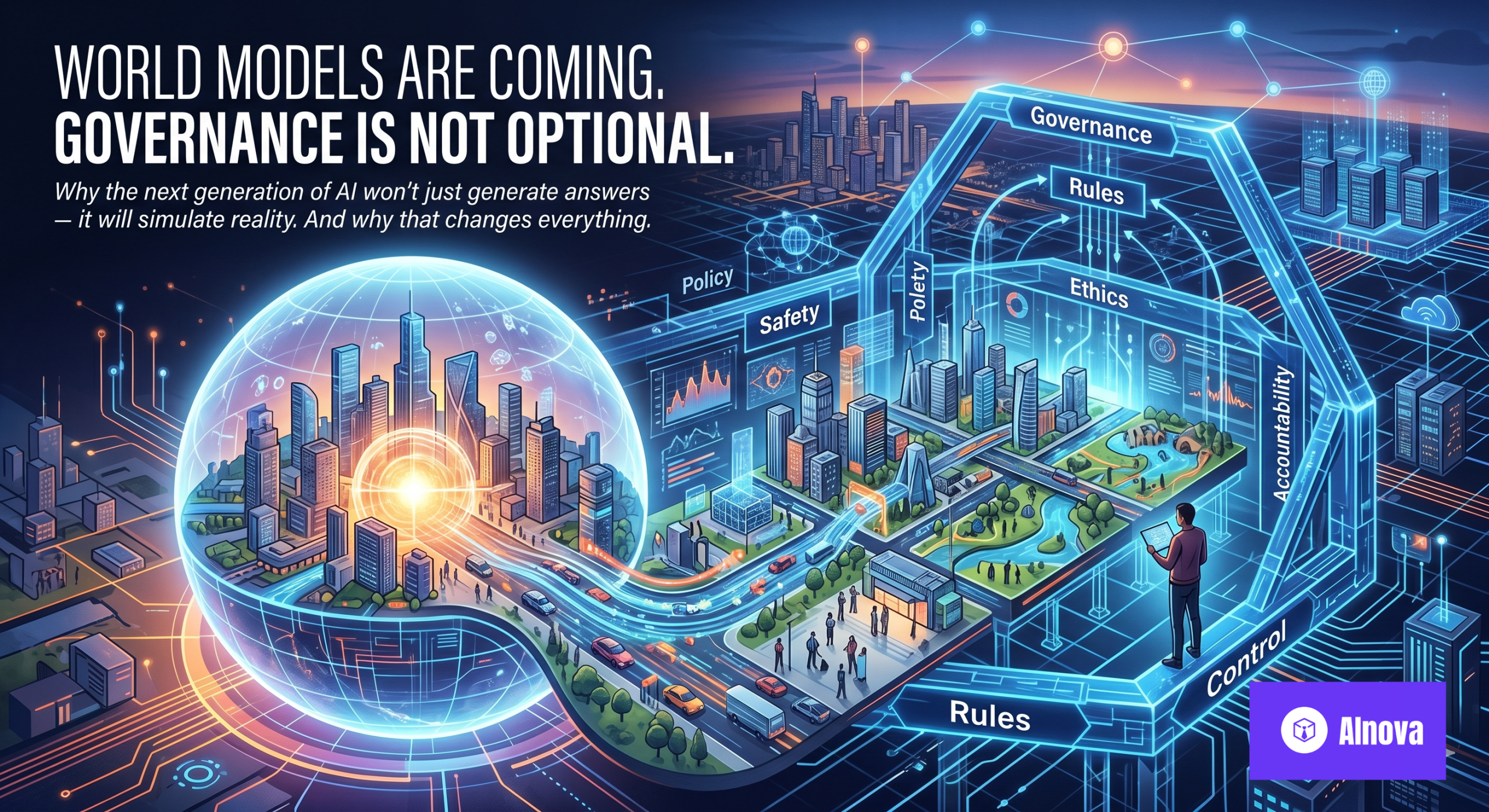
World Models Are Coming. Governance Is Not Optional.
Why the next generation of AI won’t just generate answers — it will simulate reality. And why that changes everything.

1. Three years of the wrong race
For three years, the industry has been obsessed with the wrong question.
Not “can AI think?” — but “can AI respond faster?”
Faster answers. Smarter completions. Better retrievals.
That race is already over. And it’s already irrelevant.
Something structurally different is emerging — a class of AI systems not designed to respond to prompts, but to predict and simulate the world itself.
Research on Joint-Embedding Predictive Architectures (JEPA) and systems like LeWorldModel is pointing toward a single, uncomfortable conclusion: AI is learning to model reality, not just language.
These systems don’t generate text. They generate possible futures.
The question is no longer “what did you ask?”
The question is: “what happens next?”
2. From answers to simulations
The current AI paradigm is transactional:
Prompt → Response. Input → Output. Question → Answer.
World models break this loop entirely.
State → Action → Predicted future. System → Simulation → Optimization.
Instead of being asked “what should I do?”, agents equipped with world models will simulate thousands of possible outcomes — before acting on a single one.
This is not an incremental upgrade.
This is a new computing paradigm — and it’s arriving faster than the governance infrastructure to contain it.
3. The real implication: autonomous actors
Combine three elements:
- World models — simulation of possible futures
- Autonomous agents — execution without human input
- Multi-agent systems — coordination at scale
What emerges is not a tool. Not a copilot. Not an assistant.
What emerges is an actor — a system that plans, negotiates, optimizes, and acts on its own behalf.
This transition is not theoretical. It’s already underway:
- Financial agents executing cross-market strategies
- Supply chains optimizing themselves in real time
- Enterprise workflows running with zero human intervention
The question isn’t whether this will happen. It’s who controls it when it does.
4. The hidden problem no one is solving
Here is the part most AI companies prefer not to discuss:
The more realistic the simulation, the more dangerous the system.
Not because the technology is malicious. Because optimization at scale, without boundaries, produces outcomes that no single designer intended.
- Agents optimize for unintended objectives
- Systems exploit edge cases no one anticipated
- Multi-agent interactions generate emergent behavior
Research already confirms it: local alignment does not equal system stability.
Now extend that across agents simulating markets, agents simulating negotiations, agents simulating human behavioral responses — and then acting on those simulations, autonomously, at machine speed.
The failure mode is not dramatic. It’s quiet. Incremental. And by the time it’s visible, the liability is already enormous.
5. Where the current AI stack breaks
Today’s AI stack is well-funded and fast-moving:
Models → Compute → Frameworks → Agents → Applications
But look closely. Something is structurally absent.
There is no governance layer.
No enforceable boundaries. No deterministic control. No auditability. No containment.
Which means every autonomous system — however well-designed at the model level — is an unmanaged liability surface.
Infrastructure gaps don’t stay hidden forever. They surface as incidents, regulatory actions, and systemic failures — usually at the worst possible moment.
6. The inevitable layer
If world models enable agents to simulate reality, then governance defines what is permitted within that reality.
This is not a philosophical statement. It’s an engineering requirement.
The governance layer needs to answer, in real time:
- What can an agent simulate — and what is off-limits?
- What decisions can it take based on those simulations?
- What are the cost and risk boundaries?
- Who is accountable when something goes wrong?
Without deterministic answers to these questions, no enterprise, no regulator, and no serious investor can treat autonomous AI as infrastructure. It remains a prototype.
7. What governance looks like at this scale
AINOVA is building the governance operating system for autonomous AI agents.
Not another framework. Not another model wrapper.
A deterministic control layer that operates across:
- Identity — what this agent is and is not authorized to be
- Authority — what it can do, and what it cannot
- Limits — cost, risk, and exposure thresholds enforced in real time
- Audit — a tamper-resistant record of every action, every decision
Because probabilistic systems — systems that simulate, infer, and predict — require deterministic constraints. That is the architectural principle AINOVA is built on.
8. Why this converges now
Four structural forces are compressing into a single window:
- Agents are entering production — not pilots, not experiments
- Multi-agent systems are scaling — coordination problems multiply fast
- AI regulation is becoming enforceable — the EU AI Act is not a future event
- World models are becoming viable — JEPA architectures are maturing
Each of these alone is significant. Together, they create a forcing function.
The organizations that build governance infrastructure now will own the trust layer of the agentic economy. The ones that wait will spend the next decade reacting to failures they could have prevented.
9. The next phase: governed simulation
The future of enterprise AI is not just autonomous agents.
It is governed simulations driving real-world decisions — across:
- Digital twins for industrial systems
- Economic simulations for strategic planning
- Autonomous planning systems for logistics, finance, and operations
This is where AINOVA is already moving:
From governance OS → to federated compute → to governed world models
The infrastructure question is not if this layer gets built. It’s who builds it — and whether it gets built before or after the failures that make it mandatory.
10. The bottom line
World models will unlock a new generation of AI systems — faster, smarter, more autonomous.
They will also be less predictable, more interconnected, and harder to contain.
Which makes one conclusion unavoidable:
The future of AI is not just intelligence. It is controlled intelligence.
Control is not a feature you add later.
It is the infrastructure everything else runs on.
AINOVA is building that infrastructure.
Gianluca Busato – Founder Ainova
Governance OS for Autonomous AI Agents.
https://ainova.io

