

The unsexy work that separates real platforms from demos
What Ainova just completed — and why it matters more than a new feature launch.

There is a moment in the life of every serious platform when the most important work becomes invisible.
Not invisible because it is unimportant — invisible because it does not produce a screenshot, a demo video, or a press release. No new button. No new endpoint. Just the deep, disciplined work of making a complex system actually behave the way it claims to.
Ainova has just completed that moment. And the implications extend well beyond an internal milestone.
“Most platforms show value in a demo. Far fewer maintain coherence when you go deep into runtime, governance, deployment, and operational responsibility.”
WHY THIS PHASE EXISTS — AND WHAT IT SIGNALS
The agentic AI era is no longer theoretical. Autonomous research agents, multi-agent orchestration systems, and AI-driven workflows are moving from pilots to production. But one fundamental question remains largely unsolved: how do you govern complex agent ecosystems once they start scaling?
Most current frameworks focus on capabilities. Very few focus on control, accountability, and governance. Ainova was designed precisely for this challenge.
When you build a governance platform for autonomous AI agents, the architecture decisions you make early become either load-bearing walls or time bombs. The difference only becomes visible under real operational pressure — when agents start interacting with real systems, real data, and real stakes.
The consolidation phase Ainova has just completed is precisely about defusing those time bombs before they detonate. It is a deliberate choice to trade short-term feature velocity for long-term structural integrity.
For investors and enterprise operators, this distinction matters enormously. It is the difference between a platform that looks governed and one that is governed.
SIX AREAS OF CONCRETE WORK
This phase produced measurable improvements across the full architecture. Each area targeted a specific class of fragility that typically causes agentic platforms to fail at scale.
1. Clearer separation between operational and observational layers
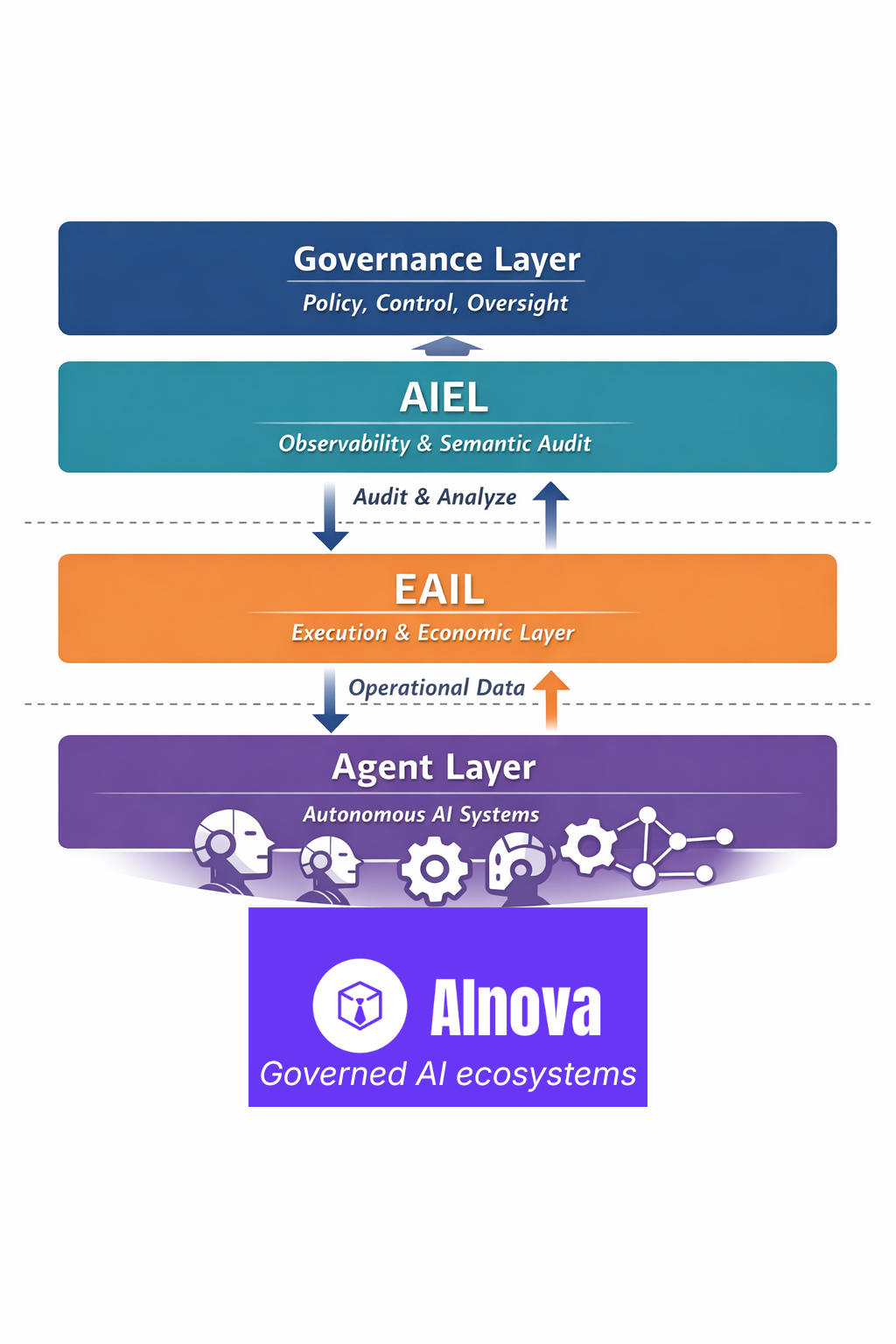
Ainova operates with two distinct governance layers: AIEL, the passive observability and semantic audit layer, and EAIL, the active operational and economic execution layer. Their relationship is now dramatically more explicit and disciplined: EAIL feeds AIEL, but AIEL does not intervene in operations.
This is not a cosmetic distinction. It determines whether a governance system can be audited independently of the system it governs — a requirement rapidly becoming non-negotiable in regulated environments. It also reduces architectural ambiguity and makes the system more predictable and governable.
2. Runtime-to-architecture coherence
Many platforms fail not because of missing features, but because their architecture drifts away from the runtime reality. Documentation, deploy scripts, and actual service states were fully realigned. This is unglamorous work, and it is exactly the work that prevents catastrophic surprises at scale.
3. Operational visibility and monitoring
A governed system must expose its own state clearly — not through informal interpretation, but through explicit, reliable surfaces. Ainova’s monitoring layer was hardened to distinguish reliably between services that are online, degraded, or simply not yet active. This improves operational readability: an essential capability for any platform orchestrating complex agent behavior.
4. Governance model consolidation
Ainova is not simply an automation platform. It is designed as a governance layer for agent ecosystems. This cycle strengthened the authority model, policy boundaries, control flow validation, and alignment between governance rules and runtime behavior. The focus was not only on what the system can do, but on how and under which constraints it can do it.
5. Provider and secret management
Many systems become brittle precisely at the intersection of runtime logic, external credentials, integrations, and governance. Ainova’s provider management was consolidated around a platform-scoped model that reduces ambiguity between provider ownership, capability abstraction, and policy enforcement.
6. Infrastructure readiness for the next evolution
Finally, the phase strengthened the infrastructural base for self-hosted deployments, infrastructure fallbacks, and deeper observability — not because those capabilities launch today, but because the architectural base to support them correctly is now in place. Ainova is not only more stable today. It is structurally better positioned to grow without losing control.
WHAT THIS UNLOCKS
The next significant milestone for Ainova is the transition from a platform that coordinates and governs existing agents to one capable of creating native agents — agents that are governed from the moment of instantiation, not retrofitted with governance after the fact.
Most current approaches to AI governance are applied post-hoc — guardrails bolted onto systems built without them. Ainova’s proposition is different: governance as a native property of the agent lifecycle, not a constraint imposed on top of it.
Agents that are born inside the governance framework. Not attached to it afterward.
That proposition only holds if the foundation is solid. It is now.
THE SIGNAL FOR ENTERPRISE AND INVESTORS
The real outcome of this phase is not “more functionality”. The real outcome is more order inside the system — visible in three specific dimensions:
- Clearer separation between observational and operational layers
- Stronger alignment between architecture, deployment, and runtime
- More explicit governance across decision points and execution boundaries
A team that chooses to spend a full development cycle on structural coherence — when they could instead be shipping visible features — is a team that understands what it is actually building. It is a signal of technical maturity, long-term orientation, and a clear-eyed understanding of what enterprise-grade governance infrastructure actually requires.
Agentic AI systems are moving from experimental deployments to production environments. The governance question is no longer theoretical. The platforms that will matter are the ones built to hold under real operational pressure — not just the ones that demo well.
Ainova is being built to hold.
Phase in numbers
2 governance layers with explicit enforced separation 6 structural fragility classes addressed 0 new features — by design
Ainova is a deterministic governance platform for autonomous AI agents built on the LungClaw governance engine. Learn more at ainova.io.
If you are working on agent systems, orchestration frameworks, or multi-agent infrastructures — or evaluating this space as an investor — we would love to connect.
Ainova Team

