

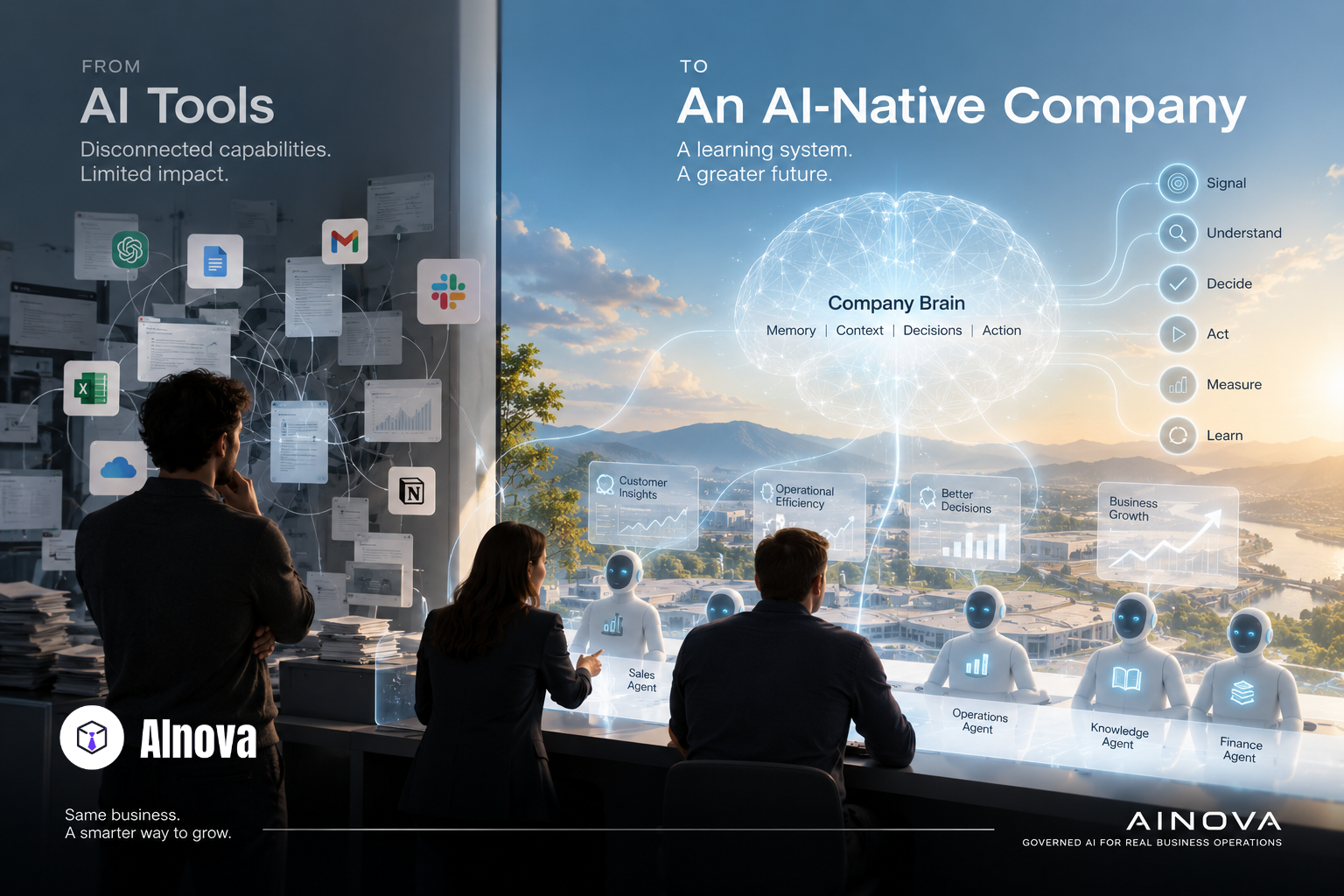
The AI-Native Company Is a Learning System, Not a Collection of AI Tools
The next competitive advantage will not come from having more chatbots, more agents or more automation. It will come from a company’s ability to continuously turn what happens in the business into knowledge, better decisions and increasingly effective action.

Over the past two or three years, the digital market landscape has shifted significantly—and perhaps even more so the processes of change and evolution affecting the corporate world. Setting aside major enterprises, corporations, and multinationals for a moment, if we focus on small and medium-sized businesses, we observe keen interest and curiosity regarding the opportunities AI offers, alongside a natural hesitation in decision-making—understandable given the pioneering stage we are currently in. Processes that once would have required decades of organizational change can now be set in motion in a matter of weeks or even days. This represents a monumental shift—primarily in mindset and openness to a new world destined to supersede the old, and much of the present, if we fail to rise to the challenge.
For this reason, we want to discuss a new phenomenon—one so radical that it highlights the high stakes for companies across every sector: the choice between survival—by charting a path of AI-driven innovation—or obsolescence, potentially being supplanted by entirely new business models that may no longer require employees. Picture a solo entrepreneur—perhaps just 12 or 15 years old—working from a small room with an internet-connected PC, whether in San Giovanni Lupatoto or a remote village in Vietnam. It is therefore crucial for entrepreneurs to read the following lines carefully, lest they be swept away by this epochal tsunami of transformation.
Over the past few years, artificial intelligence has entered organisations at remarkable speed. It first appeared through relatively simple tools capable of generating text, summarising documents and analysing information. It is now progressively expanding into systems that can interact with company data, applications and operational processes.
This evolution, however, creates a potential misunderstanding.
A company that uses a great deal of AI is not necessarily an AI-native company.
An organisation may deploy dozens of intelligent applications, several specialised agents and multiple automated workflows while continuing to operate according to an essentially traditional organisational model. Information may remain fragmented across different systems, decisions may still depend on individual employees reconstructing the relevant context, and what is learned in one process may never become part of the organisation’s broader knowledge.
The more interesting question, therefore, is no longer simply how much AI a company uses, but how deeply intelligence is embedded in the way that company observes what is happening, understands context, makes decisions, acts and learns from the consequences.
This, in my view, is where the idea of the AI-native company really begins.
Using more AI does not necessarily make a company AI-native
Consider two companies.
The first uses a generative assistant to write documents, an AI-enabled CRM, a meeting transcription system, content generation platforms and several automations connecting different applications. Marketing experiments with new models, sales uses intelligent prospecting tools, finance automates selected activities, and management has access to increasingly sophisticated dashboards.
At first sight, it looks highly advanced.
Yet a closer look may reveal that each system still operates largely independently. Knowledge generated by sales does not automatically become useful to operations. The reasoning behind important decisions remains hidden in emails or in people’s memories. A problem solved today does not necessarily make the organisation better at dealing with the same problem tomorrow.
Now consider a second company.
When a new commercial signal appears, the organisation can connect it with the customer’s history, previous interactions, purchased products, commercial conditions and relevant internal knowledge. A digital role can prepare an analysis, suggest possible courses of action and assemble the context a human decision-maker needs. Once a decision is made, the system can support its execution, measure the result and preserve what happened as part of the organisation’s memory.
The second company might actually use fewer AI tools than the first.
The difference is that intelligence is no longer distributed across a collection of isolated tools. It is embedded in an operating loop.
That loop is what matters.
From AI as a tool to AI as an operating model
The first phase of AI adoption has naturally focused on individual productivity. We began using artificial intelligence to write faster, summarise documents, analyse spreadsheets, create presentations, produce content and search for information.
This was an important stage, and it will continue to create substantial value.
Improving an individual activity, however, is not the same as transforming the system in which that activity takes place.
If we use AI to prepare a commercial proposal more quickly, for example, we may significantly reduce the time required to produce the document. Yet if employees still need to reconstruct the customer’s history manually, search through old folders for comparable projects, open another system to verify margins and then fail to capture what happened after the proposal was sent, we have improved a task without fundamentally redesigning the process.
The transition towards an AI-native model begins when organisations ask a different question:
If we designed this process today, knowing that intelligence, knowledge, memory and execution could be continuously available, would we still build it in the same way?
This is a much more consequential question than “where can we add AI?”, because it forces the organisation to reconsider the way work itself has been structured.
At that point, artificial intelligence gradually stops being simply another productivity tool and begins to become part of the company’s operating model.
The fundamental unit of an AI-native company is the learning loop
One useful way of understanding this shift is to see an organisation as a collection of loops through which events, signals and changes are progressively transformed into decisions and responses.
We can represent the cycle simply as:
Signal → Understand → Decide → Act → Measure → Learn
This is not merely a technical architecture. In many ways, it is a description of how organisations already function.
Everything begins with a signal. A request for quotation arrives, a customer suddenly reduces orders, a machine behaves unusually, a payment becomes overdue, a prospect opens a new facility or a regulatory change affects the business.
Detecting that signal, however, is not enough. The organisation needs to understand it within the relevant context. If a customer reduces purchases, for example, we need to know who that customer is, how valuable the relationship has been, what they previously purchased, which margins they generate, who has interacted with them and whether similar patterns have appeared in the past.
Only then is it possible to make a genuinely informed decision.
Artificial intelligence can play a powerful role at this stage by retrieving information, comparing precedents, identifying anomalies, constructing scenarios and proposing possible courses of action. A well-designed AI-native architecture, however, must also make authority explicit. In some cases, a human will remain responsible for the decision; in others, the system may be authorised to act autonomously within clearly defined boundaries.
The decision must then become action. That might mean contacting a customer, preparing a quotation, changing a schedule, opening a service ticket, requesting an approval or updating another business system.
But the loop cannot end there.
The organisation must observe what happened afterwards. Did the customer respond? Was the proposal accepted? Did the actual margin match the expected margin? Did the intervention solve the problem? Did the process become faster?
Only when that outcome is fed back into the system and used to improve future decisions does the loop genuinely close.
That final stage — Learn — is what turns automation into something much more powerful.
The real advantage is not automation. It is memory.
There is a great deal of discussion about AI agents and comparatively little about organisational memory.
Yet memory may become one of the defining capabilities of AI-native companies.
A surprisingly large proportion of what a business knows does not live inside structured databases. It exists in emails, documents, conversations, exceptions handled years ago and, above all, in the experience of people.
An experienced technician may recognise a problem from a seemingly insignificant change in a machine’s behaviour. A salesperson may remember why a customer rejected a proposal three years earlier. A founder may know precisely why one supplier is preferred over another even though those reasons were never formally documented anywhere.
Generative AI has made this unstructured knowledge dramatically easier to access, but building genuine organisational memory requires more than retrieving text.
The organisation needs to understand where information came from, how reliable it is, when it was produced, who is authorised to use it and under which circumstances. It needs to distinguish an approved policy from a draft, a verified fact from a hypothesis and current information from something that has become obsolete.
Even more importantly, it should increasingly preserve not only what was decided, but also why the decision was made and what happened as a consequence.
When this body of knowledge becomes accessible to both people and digital systems, something begins to emerge that goes far beyond a document repository.
At Ainova, we describe this as a Company Brain: not a giant corporate chatbot containing every company document, but a shared cognitive layer through which the organisation can remember, connect information, reason, act and govern while maintaining visibility over sources, responsibilities and decisions.
Digital Colleagues become more valuable when they begin to collaborate
The same principle applies to agents.
It is relatively easy to imagine a Sales Agent finding prospects, a Proposal Agent preparing quotations, a Knowledge Agent retrieving documents or a Margin Analyst identifying anomalies in financial data.
Individually, each of these roles may already create value.
The more significant transformation begins when these digital roles stop operating as independent tools and start participating in the same process, sharing context, memory and governance rules.
Consider a request for quotation received by an industrial company.
In a traditional environment, an employee may read the request, manually search for similar projects, contact colleagues to estimate production times, consult the ERP to verify selected costs and eventually prepare a proposal.
In an AI-native model, the same event could initiate a process in which requirements are automatically extracted, comparable projects are retrieved, current costs and lead times are collected, expected margins are checked and relevant exceptions are highlighted. A Digital Role could then prepare a first version of the proposal for a human owner to review and approve before it is sent.
The most interesting part, however, begins afterwards.
The system can monitor the customer’s response, capture the outcome of the proposal and, if the order is won, compare actual costs, delivery times and margins against the original assumptions.
At that point, the company has not merely automated the creation of a document.
It has created a commercial learning loop in which every new proposal can benefit from what happened before.
A network of learning loops can become the company’s new operating system
The principle extends far beyond sales.
In operations, an anomaly can be detected, understood in the context of previous events, connected with possible causes and transformed into an intervention whose effectiveness is subsequently measured.
In customer service, a request can be compared with similar cases, enriched with the customer’s history and routed towards an appropriate resolution, allowing each new case to improve the handling of future ones.
In compliance, a new obligation can be linked to affected processes, required controls, responsible owners and supporting evidence, creating a traceable record of why particular actions were taken.
Management can benefit from the same logic. A change in a KPI can trigger the reconstruction of relevant context, possible causes can be identified, alternative responses can be evaluated and the effects of the chosen decision can subsequently be observed.
As these loops begin to connect, the organisation starts to behave differently.
It becomes less like a collection of departments operating separate software systems and more like a network of interconnected decision systems, through which information, knowledge and outcomes can progressively circulate.
To me, this is one of the deeper characteristics of an AI-native enterprise.
The role of people does not disappear. It changes.
One of the most common misconceptions surrounding AI-native companies is the idea of an almost fully autonomous organisation in which agents progressively replace people.
Some activities will certainly become highly automated, but I believe this image misses the more interesting transformation.
The fundamental issue is not simply replacing human work with digital work. It is redesigning where human attention is used.
An intelligent system can continuously monitor thousands of signals, collect information from multiple sources, compare historical precedents and prepare analyses. It can perform repetitive activities and, within defined boundaries, execute certain actions.
This allows people to devote a greater proportion of their attention to areas where human contribution remains particularly valuable: understanding ambiguous situations, managing relationships, negotiating, exercising judgment, assuming responsibility, dealing with exceptions and making decisions in which human context remains essential.
Seen from this perspective, the AI-native company is not necessarily an organisation with fewer people.
It is an organisation in which people and digital intelligence are orchestrated differently.
SMEs may have an unexpected advantage
When discussing this transformation, it is natural to think first about large enterprises with substantial budgets, dedicated technology teams and enormous quantities of data.
Scale, however, can be both an advantage and a constraint.
Large organisations often have to deal with dozens of legacy systems, complex organisational structures, processes accumulated over decades, information silos and highly distributed decision-making responsibilities.
An SME may have fewer resources, but it may possess something extremely valuable: the ability to redesign an end-to-end process much faster.
This means that becoming more AI-native does not require starting with a company-wide transformation.
A business can begin with quotation management, customer acquisition, technical knowledge, field service or margin control. It can identify a process important enough to create value, redesign it as a first learning loop and measure what changes.
A second loop can then be added and connected to the first.
Then a third.
The transformation happens progressively, but every additional layer can increase the value of what has already been built.
This is a very different logic from large “AI transformation” programmes that may require years before they generate visible operational results.
You do not need to transform the whole company at once
This consideration is central to the approach we are developing at Ainova.
We do not begin by asking which agent should be implemented. We begin by asking which business outcome should improve.
From there, we examine the process, identify the information sources it depends on, establish the relevant memory, define the Digital Roles involved and, crucially, determine which decisions can be delegated and which must remain under human authority.
The model can be summarised as:
Business Outcome → Process → Sources → Memory → Digital Roles → Decision Boundaries → Action → KPI → Learning
The first implementation may be extremely focused.
Over time, that solution can become part of a departmental system, share memory with other processes and interact with additional digital roles.
As these systems begin to communicate, a capability emerges that no longer belongs to a single piece of software or one department.
The foundations of a Company Brain begin to take shape.
Perhaps we are measuring the wrong thing
Over the next few years, many organisations will probably talk about how many AI agents they have deployed, how many processes they have automated or how many employees are using generative AI.
These are useful indicators, but they mainly describe the amount of technology that has been adopted.
There may be more important questions to ask.
How quickly can an organisation recognise what is changing in its business and turn that signal into a better decision? How much time passes between that decision and meaningful action? How clearly can the organisation observe what happens afterwards? And, perhaps most importantly, how much does what it learns change the way it responds the next time?
The defining competitive advantage of the agentic era may ultimately have less to do with the number of agents an organisation deploys or the amount of artificial intelligence it consumes.
It may depend instead on its ability to create increasingly effective loops between signal, understanding, decision, action and learning.
Because the difference between a company that uses AI and a genuinely AI-native company may, in the end, be surprisingly simple:
the first uses artificial intelligence to work better; the second progressively learns how to become a better company.
Gianluca Busato
Enkronos – Ainova
AINOVA — Governed AI for real business operations
A business problem can become the first governed learning loop. A network of learning loops can eventually become something much larger: the cognitive infrastructure of an AI-native company.


