

The Agentic Economy Needs an Operating System: Introducing the AEL Protocol

There are two AI agents running in your infrastructure right now.
One monitors your data pipeline and triggers downstream workflows when anomalies are detected. The other manages vendor communications and contract renewals. Both are autonomous. Both are capable. And when the first one needs the second to do something consequential, a familiar problem appears: there is no shared, verifiable coordination layer between them.
They can call APIs. They can exchange JSON. But that does not tell you whether the requesting agent had the authority to make the request, whether the instruction stayed intact in transit, or whether the resulting action will leave an auditable record a compliance team can reconstruct six months later.
If you are deploying more than two agents in production, you already have this problem. You may not have named it yet. But it is already shaping your failure modes.
The problem is not intelligence. It is infrastructure.
Over the last few years, AI capabilities have advanced quickly. Reasoning, tool use, and multi-step execution have all improved significantly. The bottleneck is no longer only what an individual model can do. The bottleneck is how multiple agents coordinate in a way that is verifiable, permissioned, and auditable.
That is where most real deployments begin to break down.
When multiple agents operate across procurement, compliance, legal review, or vendor management, organizations run into the same structural questions. How does one agent know another is authorized to receive or execute a request? How does it verify that the request is in scope? How do operators reconstruct what actually happened when an agentic chain produces an unexpected outcome?
Today, the default answer is usually some combination of custom middleware, manual approval steps, partial logging, and trust assumptions. It works just enough to get through early deployment, then becomes fragile under scale, scrutiny, and failure. Every organization building serious multi-agent infrastructure eventually hits the same wall — and rebuilds the same partial solution from scratch.
This is not a model problem. It is a coordination problem. And coordination problems are solved with protocols.
What it costs to not have this layer
The absence of a coordination protocol creates cost in several concrete forms.
In a financial services workflow, agent A detects a compliance anomaly in a vendor payment and signals that agent B should suspend the associated contract. Without a protocol layer, agent B has no reliable way to verify that the instruction is authentic, authorized, and properly scoped. The organization faces a choice: add human approval gates that eliminate the value of automation, or accept unverifiable agent-to-agent instructions flowing through consequential workflows. Most choose the human gate. The automation investment fails to return.
In a regulated audit, a multi-agent system has been operating for months across onboarding, procurement, and legal review. A regulator asks for a complete trace of what the system decided, why, and under what authority. Standard logs return timestamps and function calls. They do not return the reasoning chain, the authorization context, or a causally linked decision record. The audit fails. The system gets shut down pending documentation that was never designed to be produced.
In a debugging scenario, a twelve-step agentic pipeline produces an unexpected output at step seven. Without structured records of identity, capability, intent, action, and result for each inter-agent exchange, the engineering team cannot determine whether the failure originated in the model, the tool, the policy layer, or a downstream agent’s misinterpretation of an upstream instruction. Debugging time scales not with complexity, but with opacity.
In the cost model, every serious deployment that lacks a coordination layer ends up building one — informally, reactively, and expensively. Custom permission checks per use case. Bespoke logging per deployment. Hand-crafted approval bridges per workflow. The hidden cost of not having a protocol is not zero. It is the cumulative engineering burden of reinventing coordination infrastructure every time.
Every multi-agent system above a threshold of operational complexity will require this layer. The question is not whether you will build it. It is whether you will build it well — or inherit the cost of having built it badly.
Why HTTP is not enough
The obvious instinct is to reach for existing web infrastructure. REST APIs exist. Message queues exist. Webhooks exist. Why not just use them?
Because agents are not services.
A REST call says, in effect: “do this thing.” It carries a payload, expects a response, and that is the end of the interaction model. This works well when caller and callee are deterministic, well-specified, and operating within a stable schema.
Agents behave differently. An autonomous agent has a dynamic capability envelope that changes based on context and governance policy. It carries intent — not just instructions, but the reasoning context that justifies why a particular action is being requested. It operates under authorization constraints that are not static. And in consequential settings, it must leave evidence — not just logs, but cryptographically verifiable audit trails that establish what was decided, by whom, on what basis, and when.
HTTP can transport the bytes. It does not solve the semantics of trusted agent-to-agent coordination.
What the agentic economy needs is not a better API. It needs a transport layer that is semantically aware of what agents are.
What an operating system for agents actually means
The analogy to an operating system is not rhetorical. It is precise.
An operating system manages four things you take for granted when running multiple processes on a machine: identity (each process has a verifiable ID), capabilities (a process without root access cannot write to system directories, regardless of what it requests), inter-process communication (structured mechanisms with defined semantics and error handling), and audit (every meaningful system call is recorded in a tamper-resistant log).
These four properties are exactly what is missing from the current multi-agent stack — but at the agent layer, not the compute layer.
An operating system for the agentic economy needs to provide them as structural properties of how agents communicate: how they identify themselves to each other, declare and verify capability boundaries, structure communications with semantic context, and produce audit-grade evidence of every consequential exchange.
This is what the AEL Protocol is designed to do.
AEL Protocol: four layers, one transport
AEL — the Agentic Economy Layer — is AINOVA’s structured transport protocol for multi-agent communication. It is not a framework, a library, or an orchestration platform. It is a protocol: a defined set of message structures, verification mechanisms, and interaction semantics that any compliant agent implementation can adopt.
It operates across four layers.
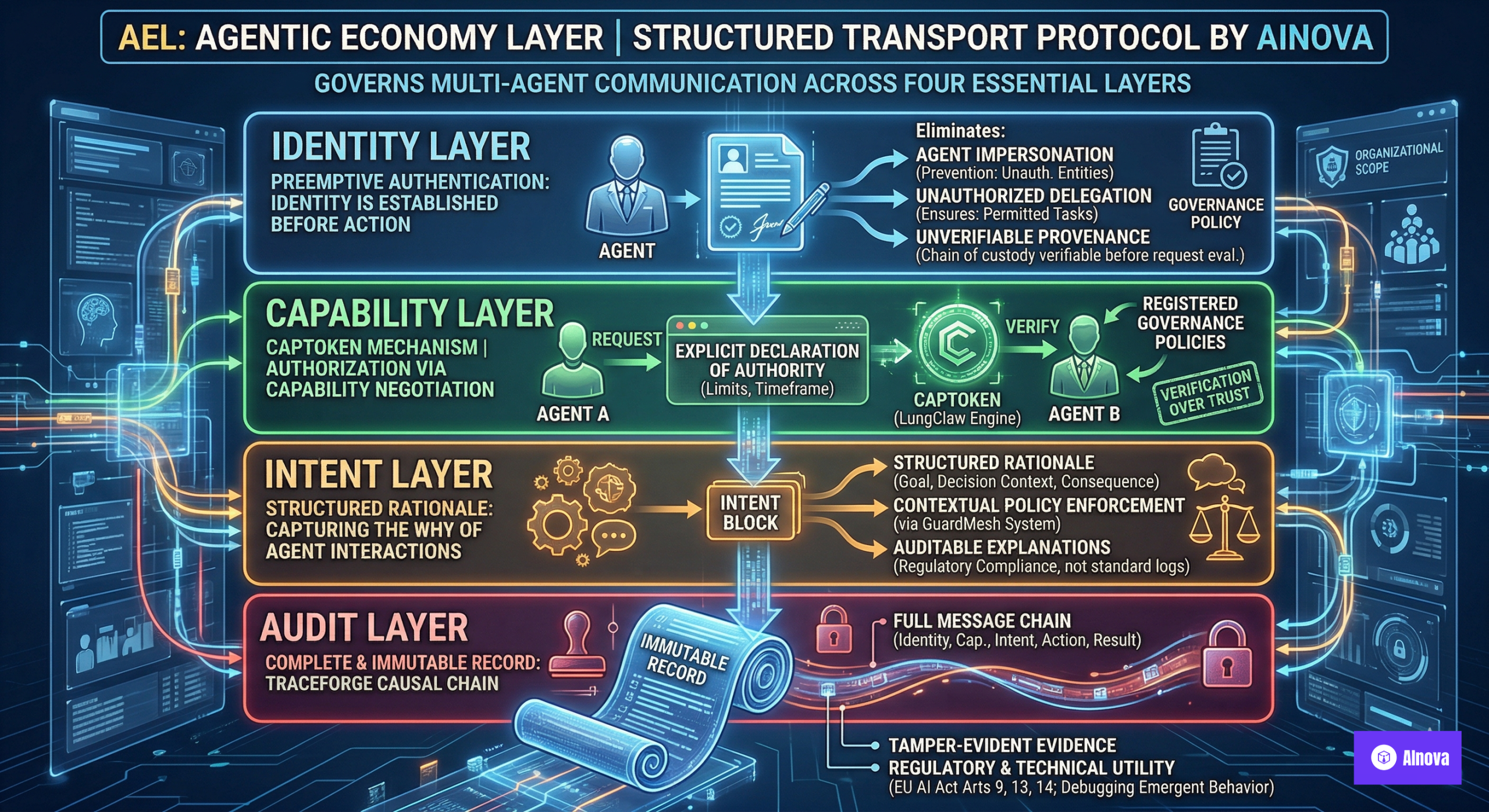
Identity layer. Every agent operating under AEL presents a signed identity assertion: which agent is communicating, under which governance policy, and within which organizational scope. Identity is established before action, not reconstructed afterward. This eliminates agent impersonation, unauthorized delegation, and unverifiable provenance at the protocol level — before any request is evaluated.
Capability layer. AEL messages carry capability assertions built on AINOVA’s CapToken mechanism, a core component of the LungClaw deterministic execution engine. When agent A requests an action from agent B, the message declares what A is authorized to request, under which limits, and for how long. Agent B does not accept the request on trust — it verifies the assertion against registered governance policies. Capability negotiation replaces capability assumption. This distinction is not cosmetic. It is the difference between an agent system that is controlled and one that merely behaves under normal conditions.
Intent layer. Every AEL message carries an intent block: a structured representation of why the request is being made — the goal state being pursued, the decision context that produced the request, and the expected consequence class. At runtime, this gives GuardMesh policy enforcement meaningful context to evaluate whether a request is consistent with declared objectives. After the fact, it gives operators, auditors, and compliance teams something closer to an explanation than a raw log entry. This is what regulators actually need, and what standard logging cannot produce.
Audit layer. TraceForge records the full message chain: identity assertion, capability declaration, intent context, action taken, and returned result — in an immutable, tamper-evident record. This is not logging. Logging tells you that a function was called. TraceForge tells you the complete causal chain: which agent requested what, from which other agent, with what authority, for what stated purpose, with what outcome. This is the level of evidence EU AI Act Articles 9, 13, and 14 require. It is also what engineering teams need to debug emergent behavior in production without spending weeks guessing at failure origins.
Why this is difficult to replicate
On paper, a four-layer architecture may look like a design document. In practice, each layer has to hold under failure, adversarial behavior, and non-deterministic model output — and that is where most ad hoc approaches fail.
LLM systems are inherently probabilistic. Governance systems are not allowed to be. If an agent crosses a capability boundary, the control layer cannot hope the system self-corrects. It must enforce a deterministic outcome: halt, reject, escalate, record. The chain does not proceed until authorization is re-established.
That enforcement logic is the difficult part.
CapToken, GuardMesh, TraceForge, and SkillPulse — AINOVA’s behavioral drift detection module — are not independent features assembled for breadth. They are parts of a single architecture built around one problem: how to impose reliable governance invariants on top of non-deterministic agent behavior without eliminating the flexibility that makes agents valuable. Organizations that attempt to build equivalent infrastructure independently typically discover this six to twelve months into the project, after significant investment has been committed to approaches that handle the happy path but fail under adversarial or edge conditions.
What looks like four modules is a coherent answer to a single hard question. That question is not answered by middleware wrapping or prompt engineering.
Why compliance is the wrong frame — and still the right entry point
The most immediate forcing function for AEL Protocol is EU AI Act compliance. Traceability, technical documentation, and meaningful human oversight all depend on better evidence and better control — exactly what AEL’s intent and audit layers are built to provide.
But compliance alone is too narrow a frame.
Compliance is a floor, not a ceiling. Organizations that treat the EU AI Act as a documentation checklist will build documentation systems. Organizations that treat it as an opportunity to build genuinely verifiable AI infrastructure will build something more durable: systems they can trust, debug, extend, and explain — to regulators, to boards, and to themselves.
The deeper value is operational trust. When you can verify, in real time, that an agent is who it claims to be, operating within assigned capability bounds, making requests consistent with declared intent, and leaving a cryptographically verifiable record — you can deploy autonomous agents into consequential workflows with a level of confidence that is simply not available in any current production stack.
That is the shift from AI as a productivity layer to AI as operational infrastructure. Compliance gets you to the table. Operational trust is what keeps you there.
The infrastructure moment
Every computing wave becomes durable when its infrastructure matures.
The internet scaled commercially when common protocol layers made interoperability possible at a level that individual integrations never could. Cloud became enterprise-grade when identity, audit, and governance controls became trustworthy enough for serious adoption — not when the underlying compute improved.
Autonomous agents appear to be approaching a similar moment. The intelligence is advancing quickly. Deployment pressure is already here. Enterprise interest is no longer hypothetical. What remains underbuilt is the coordination substrate: the layer that makes multi-agent systems verifiable, permissioned, and auditable by design rather than by patchwork.
The organizations building that layer now are not building a feature. They are building the substrate on which the agentic economy will run.
What comes next
AINOVA is opening access to AEL Protocol through the commercial beta of the AINOVA governance platform, for enterprise teams building multi-agent systems or preparing for more demanding governance and compliance requirements.
The integration path is intentionally incremental. AEL is designed to sit alongside existing orchestration frameworks, agent runtimes, and LLM pipelines — adding coordination, verification, and auditability without requiring architectural rebuilds.
If you are already deploying more than two agents into production workflows, the coordination problem is likely already in your stack. The question is whether it is being managed deliberately, or absorbed implicitly as operational risk.
Gianluca Busato – AINOVA Founder
AINOVA builds deterministic governance infrastructure for autonomous AI agents. The AEL Protocol, LungClaw execution engine, and supporting modules — CapToken, GuardMesh, TraceForge, SkillPulse — are available in commercial beta for enterprise evaluation. Connect on LinkedIn or reach out directly to discuss deployment.

