

Governed Agentic Intelligence for Mechanical SMEs: How Ainova Turns Triveneto Manufacturing Excellence into a Scalable Decision System
A case study in AI governance for North-East Italy’s mechanical sector — and a practical model for every SME-driven industry entering the agentic era.
The Industrial Laboratory That Doesn’t Need to Announce Itself
There is a strip of North-Eastern Italy — stretching across Veneto, Friuli-Venezia Giulia and Trentino-Alto Adige — that has built one of Europe’s most concentrated and resilient industrial ecosystems. Thousands of SMEs in precision components, hydraulic systems, industrial machinery, metalworking, tooling and automation compete in global markets not through scale, but through competence.
These companies are, by most measures, operationally excellent. They know materials, machines, tolerances, customers and margins. Many are family-owned, often export-oriented, deeply embedded in dense local supply chains. Italy remains one of the world’s leading mechanical engineering exporters — with machinery-related exports representing a major pillar of national industrial competitiveness and approaching €100 billion annually.
Yet this same strength is under growing pressure.
Global competition is intensifying. Margins are more fragile. Supply chains are less predictable. Skilled labour is harder to find. Customers expect faster answers, more personalisation and stronger documentation. Export markets remain essential, but managing them is increasingly complex.
In this context, artificial intelligence should not be seen simply as an automation tool. For Triveneto mechanical SMEs, the real opportunity is more strategic: using governed AI agents to transform fragmented operational knowledge into a measurable, traceable and scalable decision system.
This is where Ainova becomes relevant.
The Hidden Intelligence Problem
Mechanical SMEs in the Triveneto rarely suffer from a lack of knowledge. They suffer from knowledge that is not systematised.
It lives in the memory of the production manager who knows which machine becomes critical under certain workloads. It lives in the sales director who remembers which customer always negotiates aggressively but pays reliably. It lives in the purchasing office that knows which supplier tends to delay when raw material prices move. It lives in Excel files, ERP exports, CAD notes, email threads, old quotations, maintenance logs and informal conversations accumulated over decades.
This knowledge is genuinely valuable — but it is not governable.
A company may have thirty years of customer history and still struggle to reconstruct the full profitability of a relationship. It may have thousands of product codes and still depend on one senior employee to determine which historical quotation is comparable to a new request. It may have advanced CNC machinery and still detect production anomalies only after delays or margin losses have already occurred.
This is not a failure of entrepreneurship. It is a structural limitation of the SME operating model.
The company is intelligent. But its intelligence is not sufficiently systematised to scale, survive generational transition, or respond at the speed today’s markets require.
Why Agentic AI Is Different from Everything That Came Before
Most companies have already experimented with AI in some form: chatbots, document summarisation, email drafting, reporting, content creation. These tools are useful, but they are fundamentally reactive. A human asks a question; the system produces an answer.
Agentic AI introduces a different paradigm.
An AI agent can monitor a context continuously, interpret signals, pursue a defined goal, interact with multiple systems, prepare actions, coordinate workflows and escalate decisions when required. It does not simply respond to prompts. It participates in operational coordination — autonomously, within defined rules.
For a mechanical SME, this could mean that an agent does not merely answer a question about a delayed order. It detects the delay risk before it materialises, checks production capacity, evaluates supplier constraints, identifies affected customers, estimates margin impact, prepares alternative scenarios and routes a structured decision brief to the right manager.
But this distinction matters enormously.
Because once AI systems begin to act across production, sales, procurement, logistics and customer relationships simultaneously, the central question is no longer: “Can AI do this?”
The real question becomes: under which rules, limits, approvals and audit trail should AI be allowed to do this?
That is the governance problem at the heart of the agentic era. And it is precisely the problem Ainova is designed to solve.
The Reference Case: MecTriva
For this analysis, consider a representative SME — call it MecTriva — with the following profile:
- Sector: Precision mechanical components for automation, agricultural machinery, automotive supply chains and industrial equipment
- Employees: ~90
- Annual revenue: ~€14 million
- Structure: Three production lines, an internal technical office, a small commercial team and a purchasing function managing both long-term suppliers and occasional alternatives
- Current technology stack: ERP (partially adopted), CAD/CAM, CRM used inconsistently, Excel-based dashboards maintained by the production manager
MecTriva is not a laggard. It has invested in machinery, certifications and production technology. But its decision-making remains largely human and reactive: information arrives, someone analyses it, a decision is made. The lag between signal and response is measured in hours or days.
This is the baseline against which governed agentic AI must prove its value.
Ainova as Industrial Governance Layer
Ainova should not be understood as another ERP, another CRM or another dashboard.
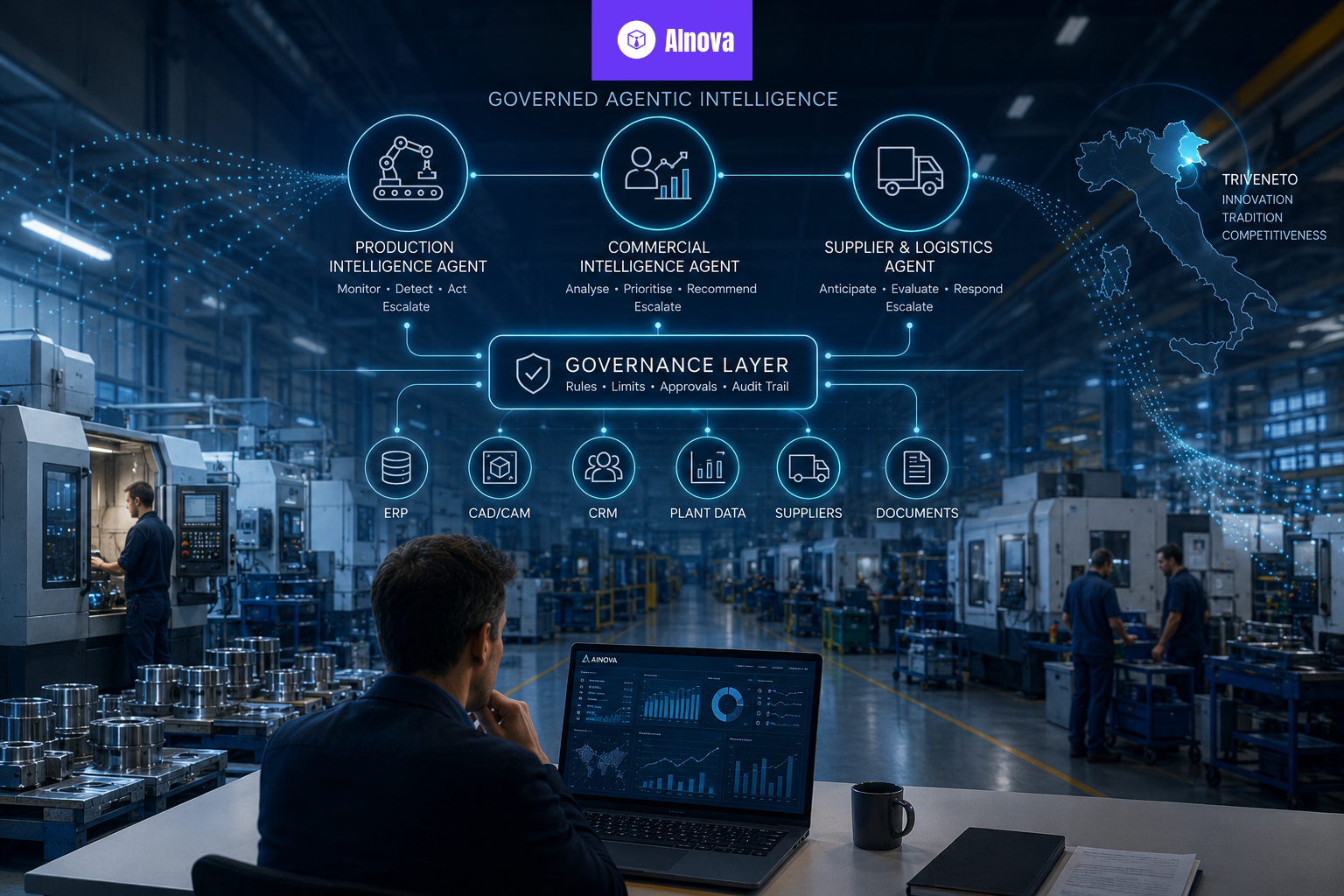
Its role is different. Ainova operates as a governed agentic coordination layer above existing company systems — connecting data, business rules, decision workflows and specialised AI agents. It allows the company to define what each agent can do, what it cannot do, when it must escalate, which human must approve, and how every action must be logged.
This is non-negotiable for industrial adoption.
In manufacturing, a wrong decision is not merely an inconvenience. A wrong quotation destroys a margin. A wrong production rescheduling delays a strategic customer. A wrong supplier change compromises a delivery commitment. A wrong compliance document creates quality or legal exposure.
Agentic AI in manufacturing must therefore be designed around bounded authority, full traceability and structured human escalation. The goal is not uncontrolled autonomy. It is controlled autonomy — the kind that an entrepreneur can trust, audit and override.

Three Agent Clusters: A Concrete Architecture for MecTriva
1. Production Intelligence Agent
The Production Intelligence Agent connects to ERP data, shop-floor records, machine utilisation logs, maintenance history, scrap rates and delivery commitments. Its purpose is to detect deviations early and enrich them with operational context.
When a CNC station shows a cycle time 12% above its historical baseline for three consecutive shifts, the agent does not generate a raw alert. It checks whether the affected product code appears in open delivery commitments with priority customers, reviews the machine’s maintenance log, cross-references with the operator schedule, and produces a structured intervention brief.
If the deviation falls within a pre-approved action category — for instance, rescheduling a non-critical batch to a parallel machine — the agent executes the change within its governance envelope and logs the action with full traceability. If the deviation affects a strategic order or requires commercial judgment, it escalates to the production manager with the brief already prepared.
The production manager does not receive a raw signal. They receive a contextualised operational assessment.
2. Commercial Intelligence Agent
The Commercial Intelligence Agent analyses order history, CRM records, customer profitability, quotations won and lost, product families purchased, payment behaviour, price evolution and recurring negotiation patterns. A richer architecture within this cluster includes several specialised sub-agents:
A Customer History Agent reconstructing the full relationship with each customer — margin trends, complaints, delivery performance, strategic value. A Quotation Support Agent helping sales and technical teams prepare offers by comparing similar historical orders, current supplier costs, production constraints and target margins. A Margin Risk Agent detecting when a quotation looks commercially attractive but is economically dangerous due to material volatility, underestimated processing time or hidden logistics costs. A Lead Qualification Agent evaluating whether a new prospect is worth pursuing, matching their apparent needs with the company’s certifications, capacity, product capabilities and strategic priorities.
The overarching purpose is to make the commercial function proactive rather than reactive. Customers that have gone silent, margins that are quietly eroding, quotation patterns that signal risk — the agent surfaces these before they become problems. When a new request arrives, the system retrieves comparable past orders, analyses price evolution, estimates margin ranges, detects missing technical information and prepares a quotation briefing. The human team still decides — but with better information and less delay.
3. Supplier and Logistics Governance Agent
The Supplier and Logistics Governance Agent monitors supplier performance, purchase orders, raw material price changes, inbound delivery reliability and production dependencies.
When a critical material delivery is delayed, the agent immediately calculates downstream impact on production, identifies affected orders, checks approved alternative suppliers, estimates cost differentials, evaluates delivery date shifts and routes a ranked set of options to the purchasing manager.
For commodity items within predefined value thresholds and with pre-approved alternatives, the agent may initiate the replacement purchase order autonomously — logging the action and full rationale. For strategic materials or higher-value decisions, it escalates.
This produces two compounding benefits: the company reacts earlier, and every decision is documented. For companies operating under quality standards such as ISO 9001 or automotive supply chain requirements, this traceability becomes a compliance asset — not merely an operational convenience.
A Market and Lead Intelligence layer within this cluster can also scan public tenders, sector news, export signals and target market developments, identifying commercial openings before the sales team would otherwise discover them.
Cross-Agent Coordination: Where the Real Value Emerges
The most powerful impact does not come from isolated agents. It comes from coordination between them.
Suppose the Production Intelligence Agent detects an available capacity window two weeks out because a batch has been rescheduled. This signal passes to the Commercial Intelligence Agent, which identifies customers with historically compatible order patterns and prepares a prioritised outreach list for the sales team: “Production window available. These three customers have placed similar orders in this volume range. Reaching out now could fill the slot and reduce idle time.”
Or: the Supplier Governance Agent detects a risk of delay in a specific raw material. The Production Agent evaluates downstream impact on scheduled orders. The Commercial Agent identifies customers that may need early communication or an alternative delivery proposal. The management team receives a coordinated risk brief — not three separate department alerts.
In a traditional organisation, this coordination requires an email chain, a cross-functional meeting, manual data queries and several hours of elapsed time. In an Ainova agentic architecture, the coordination layer is prepared automatically.
Humans remain responsible for judgment. Agents reduce the cost of discovering, connecting and pre-processing the relevant information.
Before and After: A Structural Comparison
| Dimension | Before Ainova | After Ainova |
| Production anomaly detection | Manual report review, 24–72h lag | Real-time monitoring with contextualised brief |
| Commercial follow-up | Reactive, memory-dependent | Proactive, systematised, agent-prioritised |
| Quotation preparation | Manual historical search, variable depth | Automated comparison, margin estimate, risk flags |
| Supply chain risk response | Detected after impact, reactive | Pre-emptive, ranked options pre-prepared |
| Cross-functional coordination | Meetings, emails, informal handoffs | Structured agent signals, automatic escalation |
| Decision audit trail | Partial, inconsistent | Complete, immutable, machine-readable |
| Knowledge access | Depends on individual availability | Systematised, continuously updated |
| Management attention | Absorbed by operational firefighting | Focused on judgment calls that require it |
The shift is not simply one of efficiency. It is a shift in where human intelligence is applied. Before, significant management bandwidth goes into finding problems, assembling information and coordinating responses. After, those tasks are handled by the agent layer. Human attention is reserved for the decisions that genuinely require it.
The Governance Architecture: Why It Is Non-Negotiable
There is a temptation to describe AI value in terms of productivity gains or cost reduction. These are real, but they are not sufficient for industrial adoption.
In the SME mechanical sector, trust matters more than novelty.
Entrepreneurs and managers will not delegate meaningful operational tasks to systems they cannot understand, control or audit. They need to know what the agent did, why it did it, which data it used, which rule it applied, and when a human should have been involved.
Ainova’s LungClaw deterministic execution engine enforces this rigorously:
Authority envelopes ensure every agent operates within explicitly defined action boundaries. Autonomous execution is possible only within those boundaries; everything outside escalates. Immutable logging records every action, decision and escalation with full provenance — what initiated it, what information was used, what rule was applied, what outcome resulted. Watchtower monitoring continuously validates that agents are operating as intended, flagging any deviation from expected behaviour. Policy constraints embed commercial, operational, compliance and budget limits in the governance rules — not bolted on afterward. Human-in-the-loop escalation is by design: the system is built to recognise the limits of its own authority and surface uncertainty to humans rather than resolve it autonomously.
For SMEs without large internal IT, compliance or data governance teams, this embedded governance is critical. The rules must live in the system itself — not in a separate process that no one maintains.
The Human Impact: Cognitive Leverage, Not Replacement
The concern that agentic AI will replace people is understandable — and in the context of a mechanical SME, largely misplaced.
The more accurate and valuable scenario is this: AI agents absorb low-value coordination work, freeing human capacity for judgment, relationships and improvement.
The production manager who previously spent three hours a day assembling reports and answering “what happened?” can now spend that time on “what should we do differently?” — supported by agent-generated analysis more comprehensive than any individual could produce manually. The sales team that previously relied on memory and periodic CRM cleanup now operates from a continuously updated priority list: more time in conversations, less time in administration. The purchasing function that previously spent significant effort on expediting — chasing late deliveries, managing crises — now operates with a forward-looking risk view and pre-prepared response options. The entrepreneur who previously asked “what is happening?” multiple times a day can now ask “what should we do next?” — because the system has already answered the first question.
This is not job elimination. It is cognitive leverage. For SMEs facing talent shortages, generational transition and increasing operational complexity, this leverage can be decisive.
Preserving Entrepreneurial Knowledge: The Continuity Dividend
One of the most underestimated benefits of governed agentic systems is knowledge continuity.
Many Triveneto SMEs carry a risk that rarely appears on balance sheets: much of their competitive advantage depends on people who have accumulated specific expertise over decades. They know customers, suppliers, exceptions, risks and informal operating rules accumulated over careers. But this knowledge is not codified. When these people retire, leave or are overloaded, the company loses part of its operating memory.
An Ainova-based system helps structure and preserve this knowledge over time. Agents document recurring decision patterns, connect historical outcomes to current choices, explain why certain customers require special handling, and build a reusable intelligence base that outlasts any individual.
This does not replace senior expertise. It preserves and amplifies it.
For family-owned or founder-led SMEs approaching generational transition, this may be one of the most strategically significant dimensions of the entire platform. AI can become part of the company’s continuity infrastructure.
A Realistic Implementation Roadmap
The right implementation strategy never starts with a large transformation project. It begins narrow, measurable and close to the entrepreneur’s most immediate operational pain.
Phase 1 — Data and Process Mapping (weeks 1–4): Identify key systems already in use — ERP, CRM, CAD/CAM, spreadsheets, email archives, supplier lists, production reports. Map the quotation process, customer history, supplier evaluation and margin control workflows. The goal is not a perfect data environment — it is to find where the highest-value signals already exist.
Phase 2 — Governance Design (weeks 3–6): Before deploying any agent, define authority limits, escalation rules, approval workflows, risk thresholds and audit requirements. This phase is critical. It determines what agents can do safely — and it builds the institutional commitment that makes adoption durable.
Phase 3 — First Intelligence Cockpit (months 2–3): Create a unified visibility layer for customer history, product families, margin signals, supplier reliability and production patterns. This delivers immediate value before any autonomous action is introduced — and it builds team trust in the system’s accuracy.
Phase 4 — Pilot Agent Deployment (months 3–5): Deploy one agent cluster — typically Commercial Intelligence or Production Intelligence, depending on the company’s most acute pain point. At this stage, all significant actions remain human-approved. The purpose is to demonstrate reliability.
Phase 5 — Autonomy Calibration (months 5–9): As the pilot cluster proves consistent, the autonomous action envelope expands incrementally. Low-risk, well-defined actions become semi-autonomous. High-impact or novel situations remain subject to human approval. A second agent cluster enters pilot phase.
Phase 6 — Cross-Agent Coordination (months 9–18): All clusters are operational and cross-agent coordination is active. The governance framework is embedded in quality management processes. The organisation begins using agent-generated intelligence for strategic planning, not only operational response.
Why the Triveneto Is an Ideal Laboratory — and Why It Matters Everywhere
The Triveneto is a natural fit for this model because its economy combines industrial density, export orientation, specialised SMEs and dense supply chains. Veneto is consistently identified as one of Europe’s major manufacturing regions. Friuli-Venezia Giulia hosts COMET, a recognised mechanical engineering cluster connecting companies, research actors and institutions active in the sector.
These companies are sophisticated enough to benefit from AI, but lean enough to feel the full pain of fragmented information and limited managerial bandwidth. And they share a mindset that maps directly onto governed agentic AI: process discipline, quality control, practical problem-solving, attention to measurable results.
The same rigour that governs precision manufacturing — tolerances, verification, traceability, continuous improvement — is exactly the rigour needed to deploy AI agents responsibly.
But the pattern does not stop at the Triveneto.
A construction company could use governed agents for tender monitoring, subcontractor qualification, cost deviation alerts and project risk management. A food manufacturer could use them for supply chain control, quality documentation, export compliance and demand signals. A logistics company could use them for route exceptions, customer profitability, fleet planning and operational alerts. A professional services firm could use them for client history, document analysis, deadline management and opportunity detection. A wholesale distributor could use them for customer reactivation, stock optimisation, procurement governance and margin protection.
The recurring pattern is always the same: fragmented knowledge, slow coordination, operational risk and human teams overloaded by information-assembly tasks. Wherever these conditions exist, governed agentic AI creates value.
The Questions Every Entrepreneur Should Ask
For an entrepreneur, the real promise of a governed agentic system is not that AI will do the work.
The promise is that AI will help the company become more aware, more responsive and more governable — able to answer the questions that matter every day, but that most SMEs currently cannot answer without significant manual effort:
Are we quoting correctly and at the right speed? Are we protecting margins on every order? Are we following the right customers, or the loudest ones? Are we losing opportunities because we respond too slowly? Are we too dependent on a few people’s memory? Are we using our historical data to inform current decisions? Are we detecting risks before they become operational crises? Are our AI systems operating under rules we can trust and audit?
These are not technology questions. They are competitiveness questions. And they apply to every SME — in every sector, in every geography — that operates in complex markets with lean management structures.
The Future Belongs to Governed Intelligence
The mechanical SMEs of the Triveneto have built their success through competence, discipline and adaptability. The agentic AI era does not replace that tradition. It extends it.
Ainova can help these companies transform scattered operational knowledge into governed industrial intelligence — enabling faster quotations, stronger margin control, earlier risk detection, more proactive commercial action, resilient supplier governance and durable organisational memory.
But the deeper lesson goes beyond mechanics and beyond North-Eastern Italy.
The next phase of AI adoption will not be defined only by who automates the most. It will be defined by who governs intelligence best.
For SMEs, this is the decisive opportunity: not to become technology companies, but to become stronger, faster and more strategically aware versions of themselves — companies that quote with precision, protect margins systematically, preserve what they know, and coordinate decisions at a speed their competitors cannot match.
In the coming industrial cycle, the most competitive companies will not be those that simply use AI.
They will be those that know how to govern it.
Gianluca Busato
Founder Ainova – Enkronos
AINOVA is an AI governance and agentic infrastructure platform built by Enkronos. Its deterministic execution engine, LungClaw, is designed to make autonomous AI agents safe, traceable and auditable in enterprise and SME environments — with bounded authority, immutable logging and human escalation at the core of every workflow. For feasibility studies and commercial proposals for your sector: ainova.io

