

Everyone Is Building AI Agents. Nobody Is Governing Them.

How AINOVA introduces Deterministic Governance for Autonomous AI ecosystems
The Governance Gap Nobody Is Talking About
Autonomous AI is no longer a research concept. Multi-agent systems are already operating in production environments: planning tasks, delegating work, allocating resources, making decisions that carry real economic consequences.
The industry has invested enormous energy in making these agents more capable. Better reasoning, better tool use, better coordination. Billions of dollars flow into building agents that can do more, faster, with less human intervention.
But there is a structural blind spot.
Who governs these systems once they are autonomous?
Not who monitors a dashboard. Not who reviews logs after the fact. Who enforces boundaries in real time? Who ensures that an agent cannot exceed its budget, override its authority, or scale beyond approved thresholds?
Today, most organizations deploying autonomous AI rely on a patchwork of orchestration tools, manual checkpoints, and ad-hoc rules. This works when you have five agents. It breaks catastrophically when you have fifty, or five hundred, operating across business units with real budgets and real exposure.
The missing layer is not another orchestrator. It is not a better agent builder. It is not a copilot.
The missing layer is a governance operating system.

Why Orchestrators and Agent Builders Are Not Enough
The current AI infrastructure landscape is rich with tools for building and running agents. Orchestration platforms manage workflows. Agent builders create capabilities. Automation tools handle repetitive tasks. Copilots assist human operators.
None of these solve governance.
Orchestrators manage flow, not risk. They tell agents what to do next, but they cannot enforce what agents must never do. Agent builders create capabilities, not limits. They expand what is possible, but they do not constrain what is permissible. Automation tools handle execution, not accountability. They run tasks, but they cannot guarantee that every transition is auditable, every delegation is valid, every budget ceiling is enforced.
As autonomous systems grow in complexity, the gap between execution capability and governance infrastructure becomes an existential risk. Not a theoretical one. A financial, operational, and reputational one.
The Thesis: Autonomous AI Needs a Governance Kernel
Operating systems exist because hardware alone is not enough. Without an OS, compute resources have no structure, no access control, no resource management, no shared rules. The OS does not perform the work. It governs the environment in which work happens.
Autonomous AI ecosystems face the same structural need.
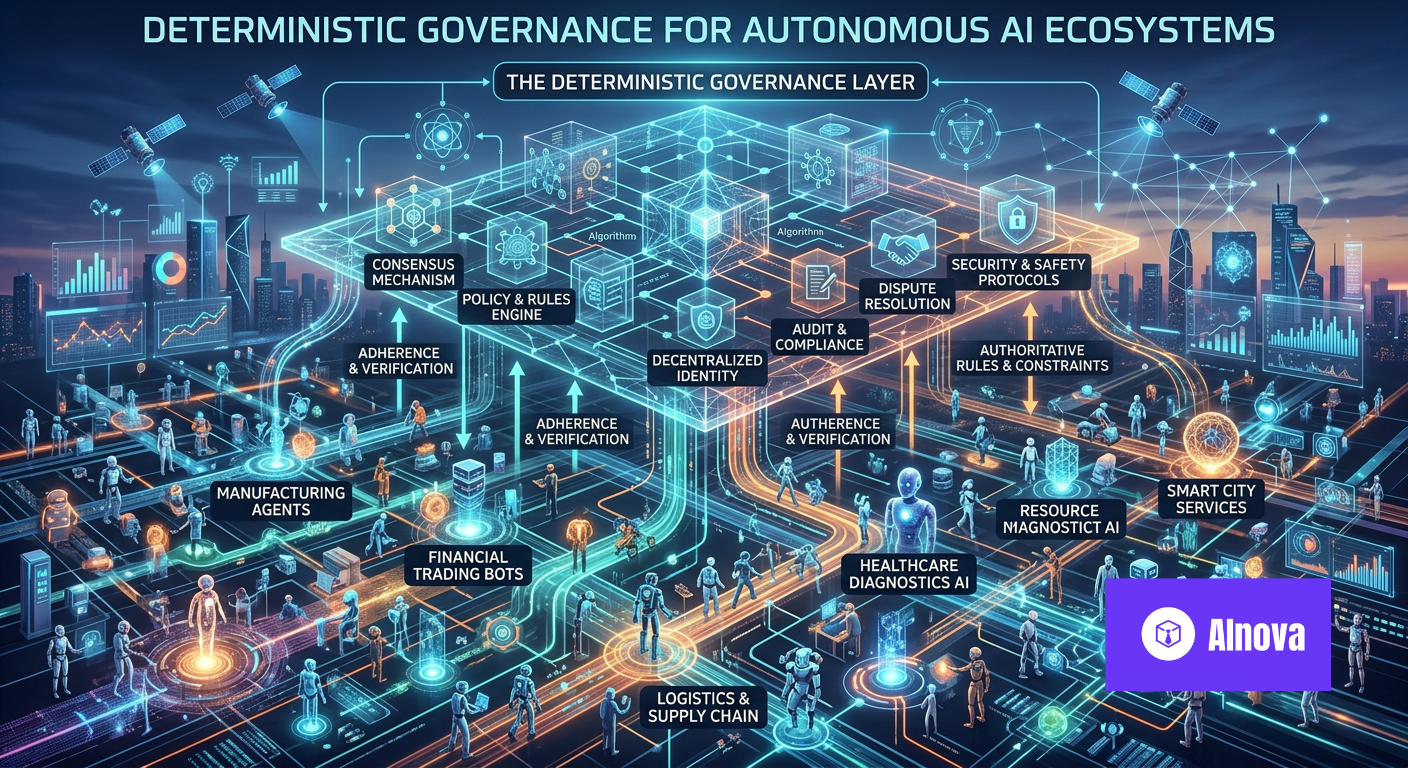
When dozens or hundreds of agents operate within an organization—each with delegated authority, allocated budgets, assigned capabilities, and defined objectives—they need more than orchestration. They need an operating system that enforces governance deterministically: not as a suggestion, not as a policy document, but as an immutable infrastructure layer.
This is the category AINOVA defines: Deterministic Governance Operating Systems for Autonomous AI.
AINOVA (ainova.io) is not an agent. It is not a copilot. It is not a workflow engine. It is the governance control plane that sits above autonomous execution and ensures that every agent, every delegation, every budget allocation, and every operational decision remains within deterministic boundaries.
A Multi-Layer Governance Architecture
AINOVA’s architecture separates responsibilities across distinct layers, each with a clear governance mandate. Rather than mixing execution with control, the system maintains a strict hierarchy: strategic governance at the top, deterministic enforcement throughout, and equilibrium validation at the base.
Strategic Governance — Enkronos Advisory
At the top of the stack, Enkronos Advisory provides the human governance layer: helping organizations design their governance architecture, model risk exposure, and configure the system for their operational context. Advisory does not alter the deterministic infrastructure. It guides its configuration.
Operational Interface — AINOVA Control Room
The Control Room is where governance becomes visible. It provides a structural visualization of the entire ecosystem: agents, groups, delegation relationships, budget bindings, risk indicators. Rather than static dashboards or post-hoc logs, the Control Room offers real-time governance visibility across policy enforcement coverage, budget containment, exposure thresholds, and operational health.
For operational teams, it surfaces objective progress, KPI performance, cost projections, and scaling impact—all interpreted within governance constraints.
Governance Control Plane — AINOVA OS
The core of the system. AINOVA OS defines the structural rules under which the ecosystem operates, organized across seven domains: Identity (governance perimeter and access control), Systems (agent registration and lifecycle), Authority (policy enforcement and delegation validation), Limits (budget ceilings, risk ceilings, stop-loss triggers), Exposure (risk simulation and cost forecasting), Registry (audit logs and governance snapshots), and Infra (infrastructure-level billing and monitoring).
Every agent, every action, every transition must pass through these governance domains. There are no exceptions, no overrides, no shortcuts.
Operational Units — AgentGroup
AgentGroup represents governed clusters of agents operating under shared constraints. In standard mode, agents run independently within shared governance policies. In operational mode, agent groups function as autonomous teams with defined objectives, KPI schemas, time horizons, budget allocations, and risk ceilings. This allows organizations to deploy goal-oriented agent teams without sacrificing governance control.
Execution, Intelligence, and Equilibrium
Below the governance layers, three additional components complete the stack. Agent Core handles deterministic execution with full traceability. AIEL/EAIL manages semantic interpretation and capability control, ensuring agents operate with consistent meaning within governance rules. Kairos Engine provides intelligence processing—inference, summarization, classification—while modeling the economic implications of every operation.
At the base sits LungClaw, the metabolic governance engine that continuously evaluates system equilibrium across governance, operational, and economic dimensions. If the system drifts, LungClaw detects it.
The Theoretical Foundation: Why Metabolic Governance Is Not Optional
AINOVA’s governance model is not an engineering heuristic. It is grounded in a formal theoretical framework called the Agentic Sustainability Theory (SAT), developed by Gianluca Busato and published as a peer-reviewed white paper on Zenodo.
SAT addresses a fundamental problem: autonomous agentic systems consume computational resources—tokens, inference cycles, GPU time—at rates that are structurally unbounded absent external constraints. Task decomposition generates sub-tasks; sub-tasks require inference; failed inference triggers retries or replanning. Without a bounding mechanism, total cost over time becomes a random variable with no finite upper bound.
The theory models this dynamic formally. Each agent’s remaining computational capacity is represented as an energy state variable that evolves over time, subject to productive drift (the net value of operations) and stochastic volatility (the unpredictability of execution costs). SAT demonstrates that a critical boundary exists: when productive drift falls below a threshold determined by system volatility, the agent undergoes a phase transition from sustainable operation to collapse. Above this boundary, the system remains stable. Below it, energy converges to zero.
This is not a metaphor. It is a mathematical result with direct operational consequences.
LungClaw (lungclaw.com) is the implementation of this theory within the AINOVA stack. It operates as a deterministic metabolic governance layer: it does not execute tasks, plan actions, or orchestrate workflows. It evaluates every proposed execution against frozen governance formulas before resources are consumed. If the expected cost-return ratio of an operation would push the agent below the sustainability threshold, execution is denied. The denial is terminal—no retry, no queue, no fallback.
As an agent’s energy depletes, LungClaw progressively tightens constraints: forcing lower-cost model tiers, shortening execution authority windows, and eventually halting operations entirely. This progressive degradation—rather than a hard budget cutoff—ensures that collapse, if it occurs, happens gradually and observably, not catastrophically.
Every governance decision is deterministic (identical inputs produce identical outputs), atomic (no intermediate states), and independently auditable. The mathematical invariants governing these decisions are frozen at deployment and cannot be altered at runtime. This is what makes LungClaw a stabilizer, not a planner.
The full theoretical framework and implementation details are documented in the LungClaw technical white paper, available as open-access publication: Busato, G. (2026). LungClaw: Deterministic Metabolic Governance for Autonomous Computational Systems.
Seven Non-Negotiable Governance Principles
Every layer of the AINOVA stack operates under seven foundational principles that cannot be bypassed or reconfigured at runtime:
Immutable Transitions — every state change is permanent and auditable. Dual Control Authority — critical operations require multi-party validation. Policy Enforcement — governance rules are enforced structurally, not advisory. Multi-Holding Scope — governance spans across organizational boundaries. Audit-Grade Persistence — every governance action is historically traceable. Deterministic Execution — outcomes follow validated governance paths with no probabilistic drift. Economic Containment — autonomous systems remain within defined economic boundaries.
These are not aspirational guidelines. They are structural constraints enforced by the system itself.
Defining a New Category
The AI infrastructure market has matured around three categories: building agents, orchestrating agents, and assisting humans. Each solves a real problem. None addresses governance.
AINOVA defines a fourth category: Deterministic Governance Operating Systems for Autonomous AI.
In this model, the governance OS does not replace agent builders or orchestrators. It operates above them, as the structural layer that ensures every autonomous operation remains bounded, auditable, and economically sustainable. Just as enterprise computing required operating systems to become manageable, autonomous AI ecosystems require governance operating systems to become trustworthy.
The Future Belongs to Governed Autonomy
The organizations that will lead in autonomous AI are not necessarily those with the most powerful agents. They are those that can deploy autonomous systems with confidence—knowing that every agent operates within validated boundaries, every budget is enforced, every decision is traceable, and every risk is contained.
Autonomy creates opportunity. Governance makes it sustainable.
AINOVA provides the infrastructure to make this possible.
Enkronos – AINOVA Team
AINOVA is developed by Enkronos. The governance architecture described in this article reflects the system currently in progressive deployment, with core governance layers already operational.
AINOVA — ainova.io
LungClaw — lungclaw.com
LungClaw White Paper — zenodo.org/records/18704803

