

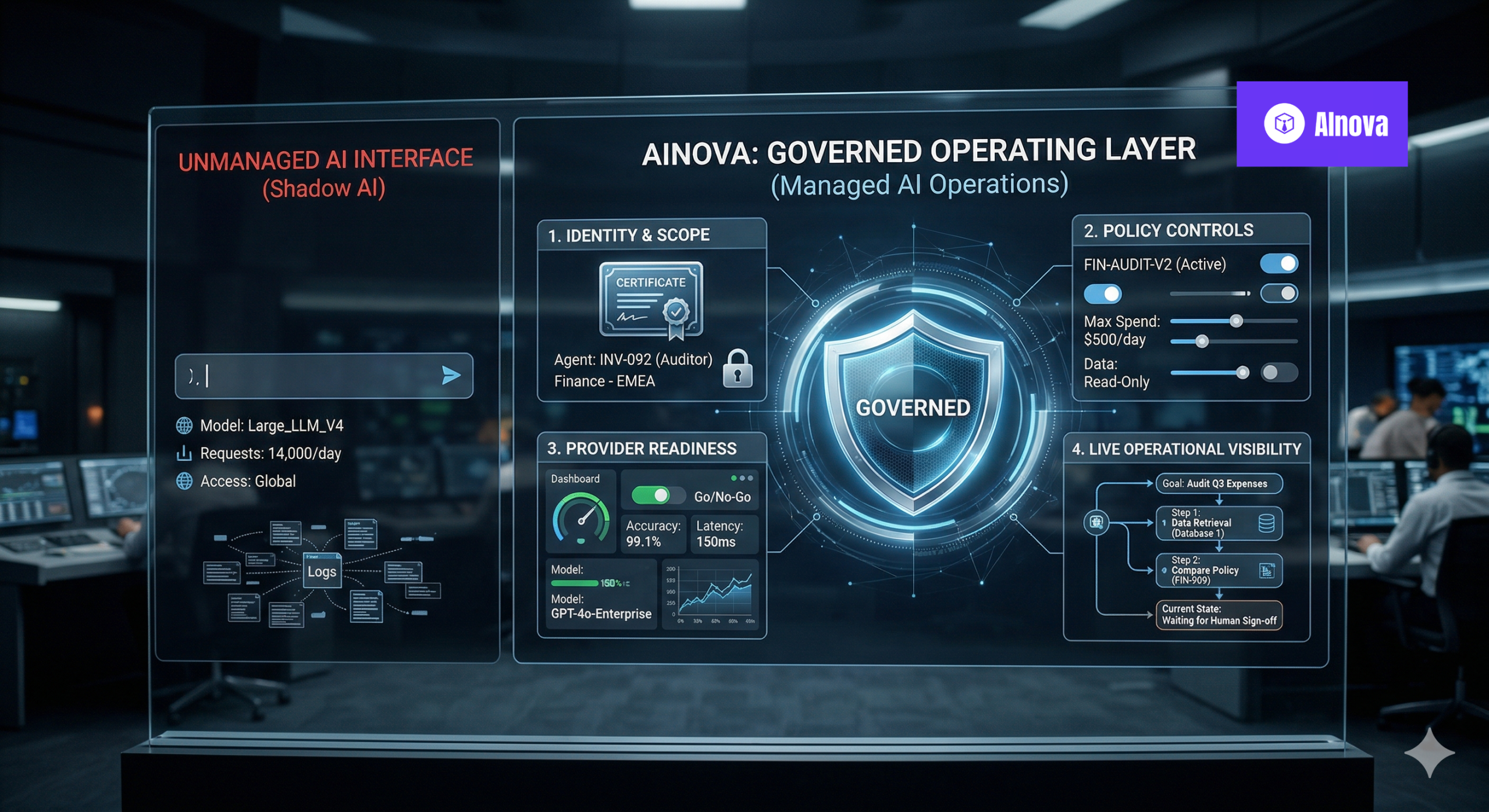
Ainova: The Operating Layer That Turns AI Agents Into a Real Business System

Most companies have already run the AI experiment. Chatbots were built. Copilots were deployed. Automation workflows were wired together. And then reality arrived: the demos worked, but the operations did not scale. Agents ran without governance. Providers were configured inconsistently. Nobody could tell, at a glance, whether an agent was actually ready to work — or why it was not.
This is not a technology gap. It is an infrastructure gap. And infrastructure gaps are where durable business value gets built.
The Problem That Actually Matters
The real challenge holding AI adoption back inside organizations is not model quality. The frontier models are good enough. The challenge is operability: the ability to deploy agents with defined identity, clear permissions, auditable policies, and verified readiness — and to manage all of that as a business system, not a collection of ad-hoc experiments.
In enterprise environments, the questions that matter are not just “what did the AI generate?” They are:
- Who is this agent, and who authorized it?
- What data can it access, and under which policies?
- Which providers does it depend on, and are they healthy?
- What are its declared capabilities, and are they currently operational?
- What is it costing the organization to run?
Today, most AI platforms cannot answer these questions. Ainova is built to answer all of them.
What Ainova Actually Is
Ainova is not another AI interface. It is a governed operating layer for AI agents.
That means organizations can use Ainova to create, register, configure, monitor, and operate AI agents inside a real management framework — with defined identity, organizational scope, policy controls, provider readiness signals, and live operational visibility.
The distinction is fundamental. Ainova does not promise vague autonomy. It delivers explicit control. Instead of “give AI to your team,” the proposition is “operate AI the way you operate any serious business function.”
This includes:
- Agent identity and registration — native agents, externally built agents, and structured templates, all managed within a single operational registry
- Provider and capability configuration — connecting the services and models agents depend on, with health monitoring and readiness verification
- Policy and governance controls — defining what agents can and cannot do, and under what conditions they are authorized to act
- Operational visibility — live status, readiness scoring, dependency mapping, and cost tracking across the entire agent portfolio
- Composable structures — agent teams, holdings, agentic business units, and multi-agent operating architectures
This is not a narrow feature set. It is the foundation of a governed AI operating system for organizations.
Why This Matters Strategically
The AI tooling market is already showing early signs of commoditization. Products that do nothing more than mediate conversation with a language model are facing aggressive price compression. The layer above — the infrastructure layer that makes agents governable, deployable, and monetizable inside real organizations — has not yet been captured by any dominant player.
That is the market Ainova is targeting. And it is the right market to target.
Infrastructure plays in enterprise software tend to produce the most durable value: they become embedded in operational workflows, generate recurring contractual relationships, and create switching costs that pure application layers rarely achieve. The analogy to cloud infrastructure is imperfect but instructive: the companies that won were not the ones with the best demos. They were the ones that became the system through which everything else ran.
Ainova’s bet is that AI agents will follow the same dynamic. The platforms that win will not be the ones with the most impressive individual agent. They will be the ones that own the layer where agents are operated, governed, and made commercially viable.
The Business Model Surface Area
Beyond direct enterprise deployment, Ainova’s architecture creates a second and potentially more compelling commercial opportunity: it enables agent-based business models.
Once agents are governed, composable, and verifiable, they become the building blocks of structured service offerings — not just internal tools. A company operating on Ainova’s layer could launch:
- A revenue growth studio — outbound and growth agents operating as a managed service
- A managed AI support desk — customer-facing agents with SLA-backed readiness guarantees
- A compliance evidence bureau — agents that generate, organize, and audit compliance documentation continuously
- A finance back-office autopilot — accounts payable, reporting, and reconciliation agents operating as a shared service
- A cyber hygiene operations center — ongoing monitoring and remediation agents running as a subscription
These are not speculative product concepts. They are business models that become viable specifically because the underlying agents are governed, composable, and auditable. The operating layer is what makes the commercial packaging possible.
The Investment Thesis in One Paragraph
Ainova addresses a structural gap in the AI adoption curve: the distance between “we tried AI” and “we run AI as a core operational system.” It is targeting the infrastructure layer that enterprise AI requires but that no dominant platform currently owns. Its governance-first architecture positions it closer to enterprise budgets and longer-term strategic contracts than application-layer AI tools. And its ecosystem model — combining internal enterprise enablement with the enablement of agent-based business models — gives it multiple paths to revenue scale. In a market full of inflated autonomy claims, a platform that competes on operational truth, clear readiness, and verified control is not just differentiated. It is trusted. And in enterprise software, trust is the compounding asset.
Execution as the Moat
Vision in AI is cheap. Every platform has a roadmap that sounds transformative. What separates durable platforms from ambitious decks is the discipline to maintain clarity about what is already live, what is bounded, and what is still being built.
Ainova’s long-term defensibility will be determined by exactly that discipline: the rigor with which it separates operational reality from forward-looking architecture, and the consistency with which it delivers on readiness, control, and transparency as core product values rather than features.
A platform that wins on operational truth does not just attract early adopters. It attracts the organizations that have been burned by AI hype before — and those organizations make the largest, most durable commitments when they finally trust what they are buying.
Who owns the future of enterprise AI?
The question is no longer whether AI agents will become part of enterprise operations. They will. The question that remains open — and that represents the real investment opportunity — is which platform will become the system those agents run inside.
The future of enterprise AI will not belong only to those who can generate agents.
It will belong to those who can make them operate.
Ainova is building for that future.
Ainova Team

