

AI Works. But What Can It Actually Do for Your Business?
From technical quotations and sales to customer service and everyday operations: over 160 potential applications of AI agents, and why now is the time to explore them.

Over the past few months, I’ve had the opportunity to meet and talk with business owners and executives from a wide range of industries. Almost everyone has expressed genuine interest in artificial intelligence, often accompanied by considerable curiosity about how it might change the way their companies operate.
Yet alongside that interest, I’ve noticed something equally common: a mixture of skepticism, uncertainty and difficulty identifying where to begin. Understandably, this translates into lengthy decision-making processes, postponed investments and initiatives that struggle to move beyond initial exploration.
Several entrepreneurs have told me they had already experimented personally with tools such as ChatGPT or Claude. They appreciated their ability to draft content, analyze documents, summarize information and offer useful suggestions. But when our conversations moved from personal productivity to business operations, the same challenge repeatedly emerged: they simply could not see how to translate those capabilities into something genuinely useful within their own organizations.
That gap between recognizing AI’s potential and understanding its practical business applications is what prompted me to rethink how we explain what is possible today.
Because in most cases, the problem is not a shortage of opportunities. It is recognizing them.
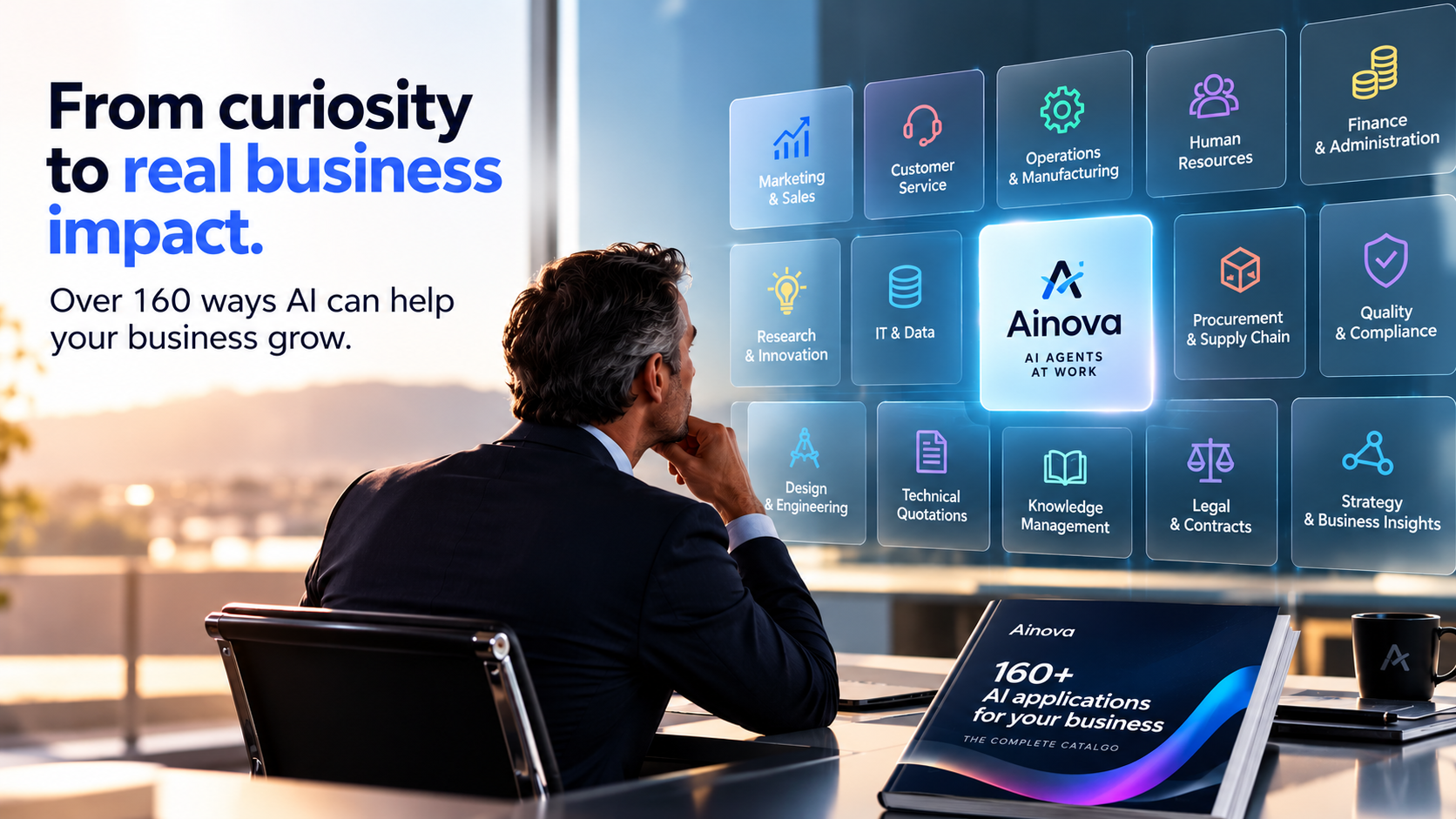
When we started mapping the applications we are developing or exploring within Ainova, together with those that could be enabled through additional integrations, we identified more than 160 business activities where AI could make a meaningful operational contribution. From prospect discovery and technical quotations to customer service, document management, manufacturing and business performance analysis.
These are not 160 features that I claim are already available as ready-to-deploy products. They form a map of possibilities: some are already being addressed within the Ainova ecosystem, some can be configured using existing technologies, and others would require dedicated projects.
But the exercise reinforced one conviction: to understand the real value of artificial intelligence, we must stop focusing on what the technology can do in theory and start examining the work businesses actually perform every day.
From AI that answers questions to AI that participates in real work
For many people, artificial intelligence is still primarily a conversational experience. You open an application, type a question and receive an answer. It is a powerful and increasingly familiar interaction, but it is not the only way AI can contribute to a business.
An AI agent can take on a more operational role. It can work toward a defined objective, consult authorized information sources, use business tools, execute a sequence of tasks and submit outcomes for review or approval.
Imagine a manufacturing company looking for distributors in Germany. With ChatGPT, a salesperson might obtain useful advice on market-entry strategies. An agentic system integrated into business processes could instead research potential distributors, gather company information, assess alignment with the company’s commercial profile, prepare prospect dossiers and organize outreach and follow-up activities through the CRM.
The difference is not merely the amount of work AI can perform. It is the ability to embed that work within an organized process where information is retrieved, activities are coordinated and outcomes are controlled.
This is the principle behind Ainova: connecting digital colleagues, business information, enterprise software and people so that AI becomes part of everyday operations rather than remaining an isolated productivity tool.
What does this actually look like? Some practical examples
The range of applications is much broader than many business leaders imagine. And these opportunities are not limited to technology companies or large enterprises.
Sales: finding prospects, identifying opportunities and maintaining relationships
For many companies, business development still relies on manual research, disconnected databases, trade-show contacts and follow-up activities that are easily postponed when everyday workloads increase.
With Ainova, businesses can configure digital colleagues to research relevant prospects, enrich company information, identify buying signals and help sales teams focus on the most promising opportunities.
Potential applications include discovering international distributors, identifying businesses announcing new investments, exploring underserved territories and reconnecting with existing customers whose relationships have become less active.
The goal is not to turn sales into indiscriminate automated messaging. It is to reduce preparatory and administrative work so that sales professionals can devote more attention to relationships, negotiations and real business opportunities.
Technical quotations: reducing repetitive work without compromising expertise
One of the applications I find most compelling, particularly for industrial businesses, is technical quotation and proposal preparation.
Consider a company designing industrial systems, machinery, electrical installations or custom-engineered components. Preparing a quotation may involve analyzing technical specifications, reviewing drawings, checking price lists, consulting historical projects and coordinating engineering and sales personnel.
An Ainova-based system can help collect and interpret incoming requirements, identify missing information, retrieve relevant parameters and prepare an initial quotation structure.
Engineering calculations must, of course, rely on appropriate formulas, algorithms and validated computational methods rather than on the generative capabilities of a language model alone. Technical accountability and final approval remain with qualified professionals.
The opportunity lies in reducing repetitive preparation, making the quotation process more structured and auditable, and allowing specialists to focus on engineering decisions where their expertise creates the greatest value.
Customer service: support that actually knows your business
A customer asks about an order’s delivery status. Another needs a technical manual. A third reports a malfunction that the service department addressed several months earlier.
In many organizations, these requests flow through email, telephone, WhatsApp and disconnected applications. Each time, an employee must reconstruct information that may already exist somewhere in the company’s systems.
An AI-agent-based service process can classify requests, consult documentation and service histories, retrieve information from enterprise systems, prepare responses and involve the right employee when human attention is needed.
These capabilities can support technical assistance, after-sales services, maintenance coordination, reservation management and communications with customers, distributors or hospitality guests.
This goes far beyond installing a chatbot on a website. It means creating a service that can use the company’s real knowledge and processes within clearly defined boundaries.
Marketing: from content generation to coordinated growth
Marketing is probably one of the areas where businesses have experimented most rapidly with AI. Yet adoption has often remained focused on generating texts, images and social media posts.
The possibilities extend much further.
Specialized agents can support market research, competitor analysis, editorial planning, newsletter preparation, campaign monitoring, SEO research and the analysis of business visibility within AI-powered search and answer systems.
When these activities connect to CRM information and commercial data, marketing becomes a more coordinated and measurable process rather than a collection of disconnected initiatives.
Strategy, creativity, brand identity and customer understanding remain essential human responsibilities. AI allows those capabilities to be supported by better research, preparation and operational continuity.
Finance, procurement and management: making business information work harder
Much of everyday administrative work still involves transferring information between documents and applications, checking consistency, monitoring deadlines and investigating exceptions.
Supplier invoices, purchase orders, delivery notes, payment reminders, pricing documents and management reports are just a few examples.
Through appropriate integrations, Ainova can support data extraction and classification, comparisons between orders and invoices, discrepancy detection, deadline monitoring and the preparation of operations requiring validation within existing business systems.
In procurement, digital colleagues can potentially compare supplier offers, analyze commercial terms, detect price changes and prepare requests for quotations.
For management teams, connecting information from CRMs, ERP systems and other applications can make it easier to understand profitability, costs, project performance, financial flows and operational indicators.
The objective is not to replace existing business software indiscriminately, but to make those systems more interoperable and extract greater value from the information they already contain.
Manufacturing, quality and maintenance: unlocking organizational knowledge
Industrial companies accumulate a remarkable amount of knowledge over time: drawings, bills of materials, manuals, procedures, maintenance reports, quality records and operational expertise distributed across different departments and individuals.
AI can help make this information more accessible by supporting procedure searches, reconstructing component histories, preparing technical documentation and identifying recurring issues in available operational data.
More advanced applications may incorporate predictive models, monitoring systems and computer vision, provided that suitable data, technical validation and appropriate safeguards are in place.
For many organizations, however, the first benefit will not be an autonomous factory. It will be something much more tangible: less scattered information, less time spent searching for it and better decisions supported by accessible organizational knowledge.
More than 160 possibilities, but no magic solution
The examples above represent only part of the activities included in our mapping exercise.
Other opportunities span funding and tender discovery, international expansion, contract management, certification monitoring, employee training, HR administration, property management, hospitality, e-commerce and many more business functions.
By combining capabilities already explored within Ainova with applications potentially enabled by additional integrations, we identified over 160 business activities that AI and agentic workflows could support.
But we deliberately chose not to present this map as an indiscriminate promise of automation.
Every process has its own characteristics. Some applications can be configured using existing components and connectors; others require new integrations, specific business rules, structured data or custom development. More sensitive processes also require additional validation, safeguards and clear human accountability.
The real opportunity is not to do everything with AI. It is to identify what is genuinely worth doing with AI.
For those who would like to explore the possibilities in greater depth, we have organized our research into a catalog of more than 160 potential business applications of AI and AI agents, grouped by business function and operational area.
The catalog is an opportunity map, not a list of features that are all currently available as standard products.
Why it makes sense to start now, even without having all the answers
Let me return to one of the most frequent observations from my conversations with business leaders: uncertainty extends decision-making because many companies believe they need to fully understand the technology before they can begin using it.
I think we should reverse that perspective.
You do not need to understand every AI model, every platform or every possible automation. You need to understand one of your business processes well enough to recognize where time, information, resources or opportunities are being lost.
AI adoption can begin there, with a limited, measurable project that fits the organization’s actual capabilities.
The advantage of starting now is not about being the first to adopt technology that will inevitably continue evolving. It is about gaining experience, understanding data requirements, learning how to govern AI-enabled processes and progressively developing reusable operational capabilities.
Waiting does not automatically solve fragmented information, complex workflows or disconnected systems, which are often the real obstacles to effective AI adoption.
I am not suggesting that companies should rush into every available AI investment. I am suggesting they should move faster in understanding where an investment could create genuine value.
You do not need to transform your entire business immediately. You need to identify the first process where measurable improvement is possible.
Agent autonomy must not mean losing control
An AI system that merely suggests a draft presents different responsibilities from an agent that accesses internal documents, updates CRM information, prepares orders or interacts with enterprise software.
As operational capabilities expand, permissions, traceability, exception management, controls and accountability become increasingly important.
Agents need clear boundaries: what information they can access, which operations they are authorized to perform, when human approval is necessary and which actions remain prohibited.
That is why Ainova is not simply conceived as a collection of disconnected agents. Our architecture aims to connect digital colleagues, business knowledge, workflows and existing systems within a governed environment where permissions, operational rules, approvals and evidence can be managed.
Automating a business process should never mean surrendering control over that process.
The first step is not choosing an AI agent. It is choosing a problem worth solving.
A commercial organization might begin with prospect discovery. An industrial business could focus on technical quotations. A service company might start with customer request handling. A hospitality operator could streamline guest communications. An organization with extensive documentation might prioritize making information easier to find.
Once the first workflow produces measurable results, the capabilities developed can be extended to other activities by reusing integrations, components and organized knowledge.
This progressive approach is central to Ainova’s vision of the Company Brain: gradually building a shared operational context in which information, people, digital agents and business tools can work together more effectively.
But companies do not need to start by understanding the entire architecture to achieve an initial benefit.
When talking with managers and entrepreneurs, I like to start with a simpler question:
“If tomorrow you had a few digital colleagues capable of working with your company’s systems and information, under your control, which activities would you delegate to them first?”
It is a very different question from “Which AI software should I buy?” And that is precisely why it can lead to much more useful answers.
AI has already demonstrated its value as an individual productivity tool. The challenge now is to translate that individual usefulness into an operational capability for the entire business.
With Ainova, we want to help organizations make exactly that transition: from curiosity about artificial intelligence to tangible business improvements, one process at a time.
Curious about what AI could do for your business?
We have mapped more than 160 potential AI and agentic applications, covering everything from prospect discovery and technical quotations to customer service and business operations.
Request the full catalog to explore potential applications relevant to your company, or get in touch to discuss a focused first project.
Gianluca Busato
Founder Enkronos – Ainova


