
You Don’t Need an AI Transformation. You Need the Right Starting Point.

From a €29 Digital Colleague to a Company Brain or a custom enterprise project: a practical way for SMEs and growing businesses to adopt AI without making it more complicated than it needs to be.
There are two common ways to make artificial intelligence unnecessarily difficult for a business. The first is to make it sound much bigger than it needs to be, turning every conversation into a discussion about transformation programmes, data architectures, governance frameworks, new platforms, agents and integrations before a single practical problem has been solved. The second is the opposite: pretending that AI is so simple that every company should be able to figure it out by itself. Give everyone a chatbot, connect some data, automate a few tasks and somehow the transformation will happen.
For most companies, neither approach is particularly useful. Businesses do not need to become AI experts. They need to understand where AI can create meaningful value, what level of technology is actually appropriate, which processes should change, which decisions should remain human and, above all, where it makes sense to begin.
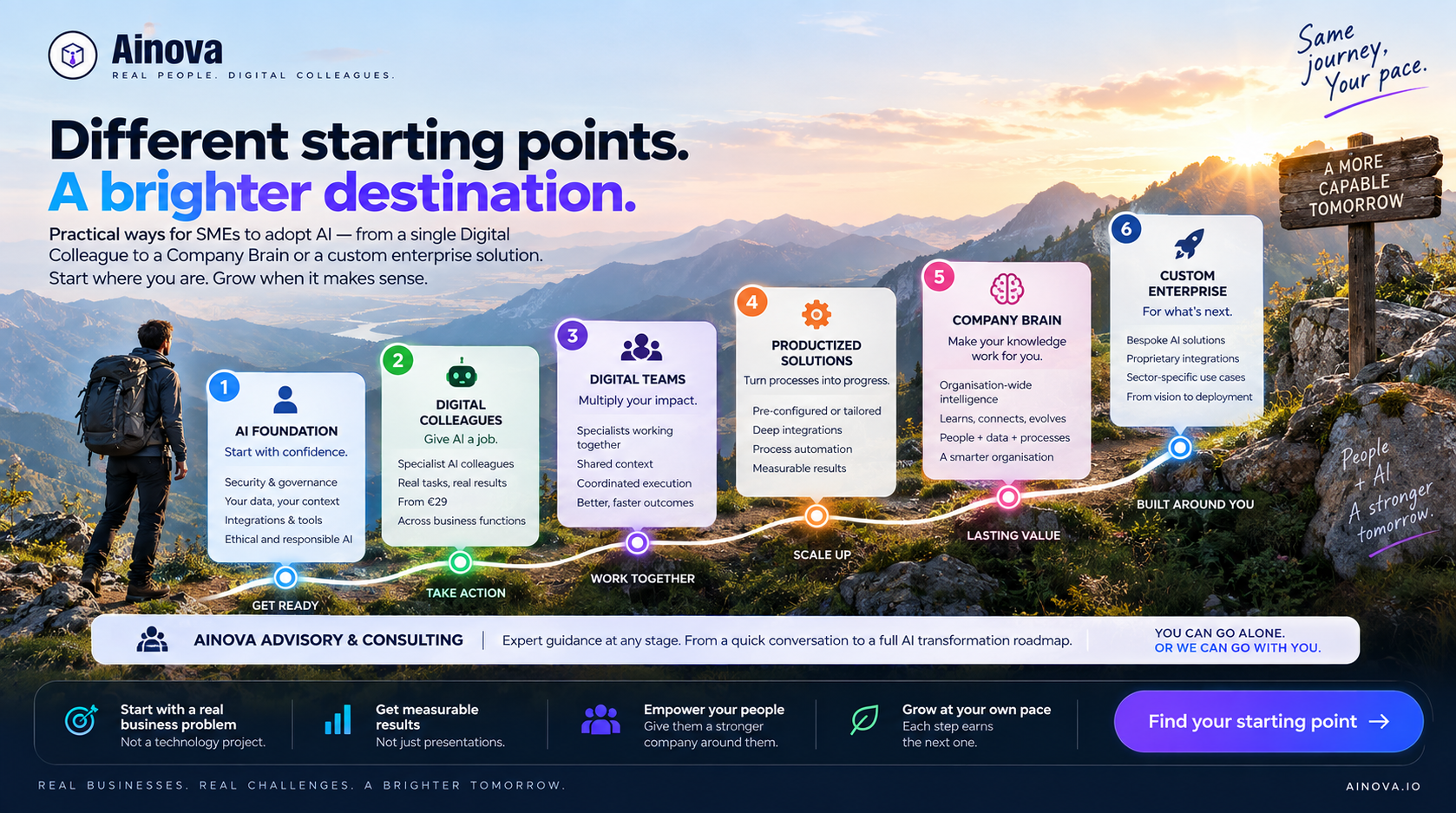
That is the thinking behind AINOVA. A company may start with something as simple as assigning one real task to a Digital Colleague. From there, it can connect that colleague to its data and tools, create Digital Teams, automate complete workflows, build an organisation-wide Company Brain or develop a deeply integrated custom enterprise solution. These are not separate visions of AI adoption; they are different starting points along the same journey.
There is another important part of the model. A business does not need to know in advance which of these paths is right for it. AINOVA’s advisory and consulting expertise can be activated at any stage, and for organisations without dedicated AI expertise, we often recommend starting there. The objective is not to introduce as much AI as possible, but to introduce the right amount of AI in the right part of the business, with a clear reason for doing so.
Start with one real job
The simplest adoption scenario is often the most useful. A sales team may need more qualified prospects, finance may have an analysis that keeps being postponed, marketing may want better competitive intelligence, HR may have documents to review or somebody may simply need to prepare a proposal by Friday.
None of these situations necessarily requires an “AI transformation”. They require work to be done.
That is where a Digital Colleague can be a practical first step. Instead of launching a technology project, the company gives a specialist AI colleague a specific assignment. An AI Sales Scout can research potential customers, a Financial Analyst can work through financial information, a Proposal Writer can support the preparation of an offer, while other specialist colleagues can assist functions such as Marketing, HR, Procurement, Compliance, Project Management, Strategy, Training, Data Analysis and Customer Service.
Some assignments can start from €29, which changes the nature of the decision. Experimenting with AI no longer has to mean making a major strategic commitment. The company can give a Digital Colleague a real task, assess the result and decide whether the capability deserves to be used again or expanded. If it does not create value, the experiment has been limited and inexpensive. If it does, the company has identified a capability worth developing.
This is often a much healthier way to start than designing a large AI programme before anyone knows whether the first use case is actually useful.
The next step is often more context, not more AI
A Digital Colleague can perform useful work on its own, but businesses do not operate in isolation and neither should artificial intelligence. A company already has customers, contracts, products, procedures, historical proposals, projects, conversations, financial information and years of accumulated experience. Much of that knowledge lives inside systems that people already use every day, such as Google Drive, SharePoint, Dropbox, HubSpot, Salesforce, Slack, Teams or email.
Once appropriate and authorised connections are introduced, the Digital Colleague can begin working with the company’s actual context rather than relying only on the information contained in a single prompt. This creates a substantial difference in what the AI can do.
There is, for example, a big difference between asking an AI system to “analyse our sales pipeline” and asking it to “review our current pipeline, compare it with the previous six months, identify opportunities that appear to be slowing down and tell us where the sales team should focus this week”. The second request becomes valuable because the system understands enough of the surrounding business context to produce an answer that can support a real decision.
This is also why AI adoption does not necessarily mean replacing the software stack a company already has. In many cases, the better strategy is to make existing systems more intelligent, more connected and easier to use.
When one Digital Colleague is not enough
Real business objectives rarely belong to a single department or fit neatly inside one job description. Imagine, for instance, that a company wants to win a new customer. One Digital Colleague could identify the prospect, another could research the organisation and its market, another could analyse competitors, another could help shape the commercial approach, while a Proposal Writer prepares the first version of an offer and a Deal Coach supports the salesperson in deciding what to do next.
Individually, these are specialist capabilities. Together, they become a Digital Team working towards a shared objective.
This is an important shift because AI begins to move beyond the familiar assistant model. Instead of asking one general-purpose chatbot to do everything, the business coordinates different specialist capabilities with shared context, defined responsibilities and human oversight. People remain responsible for judgement, relationships, accountability and important decisions, while Digital Colleagues can take on research, preparation, analysis, monitoring and selected execution activities.
The objective is not to build a company without people. It is to give people a more capable organisation around them.
Sometimes the real problem is the process
There comes a point where improving individual tasks is no longer enough. Consider what happens when a new sales opportunity arrives. The company may need to research the prospect, update the CRM, retrieve relevant documents, review previous projects, identify suitable products or services, check pricing, prepare a quotation, obtain approval, send the proposal, schedule follow-ups and provide management with visibility over the entire process.
AI can be added to each individual activity, but at some point a more useful question emerges: if we were designing this process today, knowing that intelligence could be available throughout it, would we still organise the work in the same way?
This is where AINOVA Productized Solutions and process automation become relevant. Digital Colleagues, integrations, business rules, existing software, company data and human approvals can be orchestrated around a complete business outcome rather than a single task.
The resulting process might combine a trigger, data retrieval, AI analysis, business rules, digital execution, human approval, subsequent action and continuous monitoring. The same logic can be applied to sales, procurement, finance, customer service, document processing, project management, compliance, training or highly specific industry workflows.
At this stage, AI stops being simply another tool inside the process and starts becoming part of the way the process itself is designed.
From scattered knowledge to a Company Brain
As AI adoption grows, another issue usually becomes more visible: the amount of knowledge an organisation already owns but cannot use efficiently.
Ask ten people where the company’s knowledge lives and you may receive ten different answers. Some will say the CRM, others SharePoint, project folders, the ERP, old email conversations or a spreadsheet that only one person knows how to find. Very often, the real answer is simply: “ask the person who knows”.
This is not necessarily a sign of poor management. It is a natural consequence of how companies grow. Over time, however, it creates a serious inefficiency. A business may have twenty years of experience and still behave as though it were starting from zero because previous projects are difficult to retrieve, decisions disappear inside email threads, similar problems are solved repeatedly and valuable knowledge leaves when experienced people leave the organisation.
The AINOVA Company Brain is designed to address this problem. It is not simply a larger chatbot or another document search engine. It is an intelligence layer that progressively connects people, data, knowledge, processes, tools, Digital Colleagues and Digital Teams.
A salesperson can benefit from experience accumulated across previous customers. A project manager can retrieve relevant historical work. Management can connect financial, commercial and operational signals. Digital Colleagues can work with a richer understanding of the organisation, while people can ask questions whose answers previously required searching across several systems or finding the one colleague who happened to remember what happened five years ago.
The purpose of a Company Brain is not to replace organisational intelligence. It is to make organisational intelligence easier to preserve, connect and use.
And sometimes the right solution does not exist yet
Not every business problem can be addressed with a predefined workflow or a standardised solution. A manufacturing company may want AI connected to decades of technical documentation, ERP data and production information. An engineering business may need systems capable of interpreting drawings, specifications and historical projects. A logistics company may need predictive intelligence across customs, transport, documents and supply-chain operations. Larger organisations may require proprietary Digital Colleagues, specialist models, particular security architectures or integrations with legacy systems.
In these cases, the solution has to be designed around the business itself.
AINOVA can support this type of custom enterprise project from architecture and prototyping through integrations, agents, automation, governance and production deployment. Even here, however, complexity should not be introduced for its own sake. A complex project can begin with one process, one department, one dataset or one valuable problem and expand only once the business case has been demonstrated.
The technology should follow the problem, not the other way around.
What if you know AI matters, but you do not know where to start?
For many SMEs, this is probably the most realistic situation. Management sees what is happening with artificial intelligence, competitors are experimenting, employees are already using AI tools and potential opportunities seem to exist throughout the organisation. What is often missing is the internal experience required to decide which of those opportunities should come first.
That is why AINOVA’s consulting approach is not a separate final stage of the journey. It can accompany every stage of it.
For companies without dedicated AI expertise, we often recommend beginning with a structured assessment of the business rather than beginning with technology. The relevant questions are usually very practical: where is time being lost, where are margins being lost, which activities are unnecessarily repetitive, where does information get stuck, which decisions would benefit from better data, which processes depend too heavily on individual people, what could safely be automated and where should a person remain firmly in control?
Just as importantly, the company should identify what can produce a measurable outcome in the short term. A useful AI initiative should ideally be connected to something the business already understands: time saved, faster quotations, more qualified leads, lower operating costs, improved margins, reduced errors, better customer response, lower working capital or faster decision-making.
These are business questions before they are technology questions, which is why consulting can often be the fastest path to a sensible AI starting point.
Consulting should reduce complexity, not create it
There is also a danger in consulting itself. An AI consultancy can spend months producing strategies, frameworks and roadmaps for what a company may one day want to do. That may be necessary in some enterprise environments, but it is not always what an SME needs.
Sometimes the best advisory engagement should result in something much simpler: start with this task, give it to this Digital Colleague, connect these two information sources, retain human approval at this point, measure these three indicators and review the results after 30 days.
For a more complex organisation, the appropriate work may involve an AI Opportunity Assessment, process mapping, integration architecture, governance, ROI analysis and a phased transformation roadmap. Both approaches are valid. The amount of consulting should be proportionate to the problem.
Our role is not to create complexity so that we can then sell a solution to it. It is to help companies identify the smallest sensible path to measurable value.
Different situations, different starting points
| If your situation is… | A sensible place to start |
| You have a specific task you would like AI to handle | Digital Colleague |
| AI needs access to your documents, customers or systems | Connected Digital Colleague |
| Several specialist capabilities need to work together | Digital Team |
| The real problem is an entire workflow | Productized Solution / Process Automation |
| You need to connect knowledge across the organisation | Company Brain |
| Your requirements are unique or deeply integrated | Custom Enterprise Project |
AINOVA Advisory sits across all of these options. If you know exactly what you need, you can start quickly and with a high degree of autonomy. If you do not, we can help you determine the right starting point. If the project becomes larger and more strategic, our involvement can grow with it.
From a focused discussion about one business problem to an organisation-wide AI transformation roadmap, consulting is not another product to reach at the end of the journey. It is expertise that can accompany the business whenever it is useful.
Each step should earn the next one
We believe this is one of the most sustainable ways for a company to approach AI. Instead of asking how much artificial intelligence can be introduced, it is usually more useful to ask what is genuinely worth improving.
That may mean giving one activity to a Digital Colleague and seeing what happens. It may mean connecting that colleague to real company information, adding other specialists when the objective becomes broader, redesigning an entire workflow when individual improvements are no longer enough, or building a Company Brain when fragmented organisational knowledge becomes the real constraint.
Eventually, the journey may lead to a fully custom solution that reflects something unique about the business. Or it may not. There is no requirement to reach the most complex stage.
A company using one well-designed Digital Colleague to solve an important problem may be making better use of AI than another company running an expensive transformation programme that nobody uses.
The objective is not more AI. The objective is more capability.
Find the right place to begin
If you already know which task you want to improve, you can start with a Digital Colleague. If the issue involves an entire business process, AINOVA Solutions may be the better starting point. And if you know AI could create value but you are not yet sure where, we can work with you to identify opportunities, establish priorities and define the smallest sensible first step.
Start where you are. Build only what you need. Grow when the results justify it.
Ainova Team
