

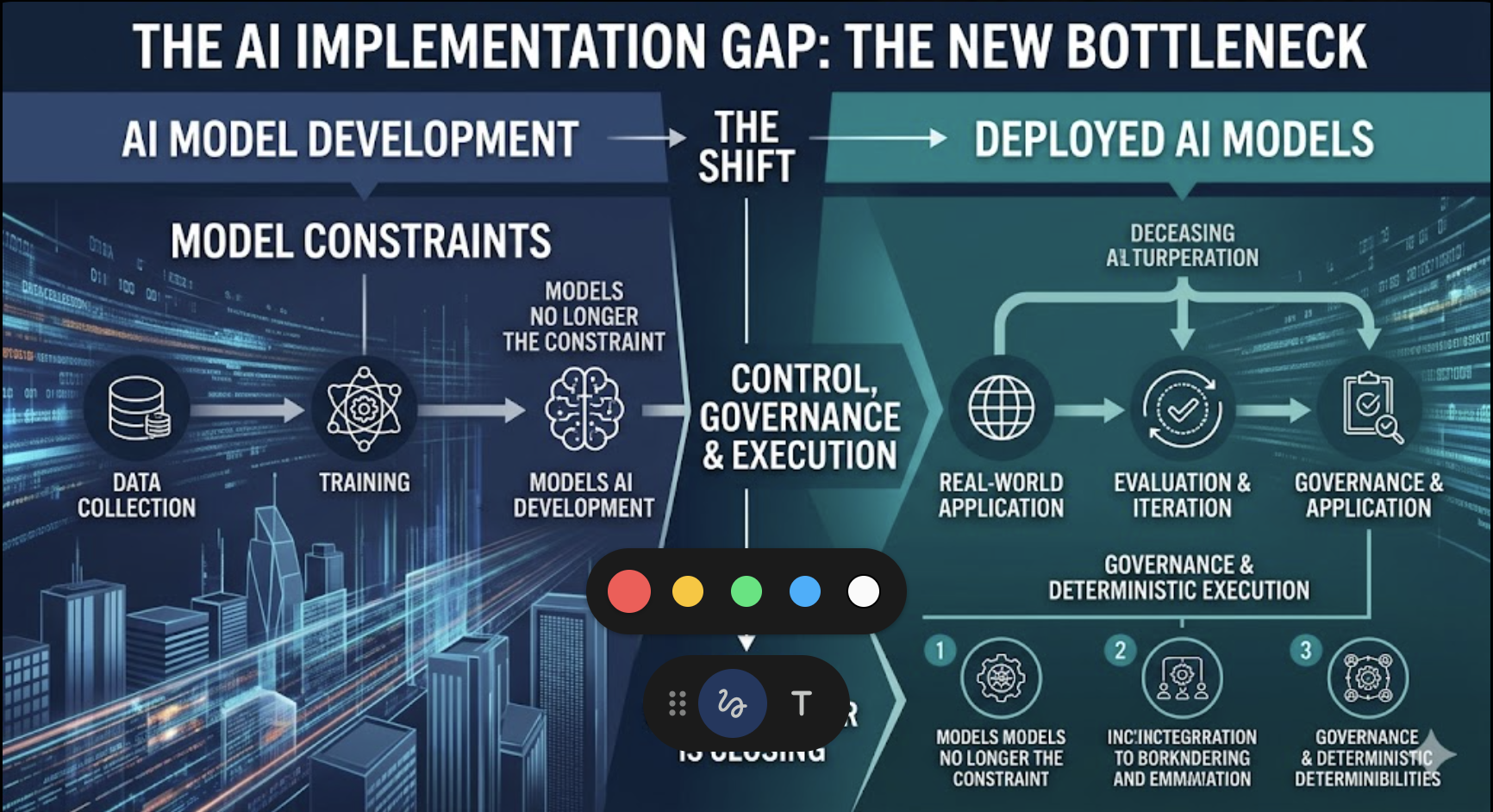
The AI Implementation Gap Is Now the Real Bottleneck
Models are no longer the constraint. Control, governance, and deterministic execution are — and the window to define that layer is narrowing.

Over the past year, the AI industry has been obsessed with a single question: which model is better?
It is the wrong question.
The competitive battlefield is no longer model quality. It is operational control.
What enterprises are discovering — often the hard way — is that access to a powerful model is not the bottleneck. The bottleneck is everything that comes after: integration into real workflows, governance of AI behavior, reliability at scale, and accountability when things go wrong.
This is the AI Implementation Gap. And it is widening faster than most organizations realize.
01 — The Shift from Models to Deployment
Foundation models are rapidly becoming interchangeable. They are cheaper, more accessible, and increasingly commoditized. Even frontier labs are acknowledging this reality: Anthropic recently launched a forward-deployed services division, embedding engineers directly into enterprise operations.
This mirrors a pattern we have seen before. In the early days of cloud computing, before AWS scaled to self-service, services companies dominated. The same dynamic is playing out in AI — but the window is narrower, and the stakes are higher.
The organizations winning today are not just buying access to AI. They are deploying it — deeply integrated into processes, with defined rules, constrained autonomy, and measurable outcomes.
02 — The Control Problem No One Has Solved
As AI systems move from pilot to production, a new layer becomes non-negotiable: operational control.
Not control in the abstract sense. Concrete, enforceable, auditable control:
- Who is authorized to take which actions — and under what conditions
- How constraints are enforced at the execution layer, not just in the prompt
- How behavior is logged, traced, and made accountable
- How AI agents are prevented from acting outside defined boundaries
Without this, AI deployments remain fragile. Unpredictable. Expensive to operate at scale. And impossible to trust in regulated environments.
The gap is not technical intelligence. It is structural governance.
03 — Where the Real Moat Is Forming
If models commoditize — and all signals say they will — defensibility lives in what sits between the model and real-world execution.
The companies building lasting value are not building better models. They are building the infrastructure layer that makes models safe to deploy at scale:
- Deterministic execution engines that enforce rules, not just suggest them
- Orchestration systems that manage multi-agent workflows without losing control
- Governance frameworks that translate regulatory requirements into operational constraints
- Audit trails that satisfy compliance obligations and build trust with stakeholders
This is infrastructure. And infrastructure, once embedded, is extremely difficult to displace.
04 — The Three-Phase Architecture of AI Maturity
Looking at the market today, three distinct phases of AI maturity are emerging — and most enterprises are only beginning phase two:
- Phase 1. Model innovation — largely solved at the frontier level. GPT-5, Claude 4, Gemini Ultra. The race continues, but differentiation is narrowing.
- Phase 2. Deployment and services — now exploding. Forward-deployed teams, deep integration, outcome-based AI delivery. This is where most investment is flowing today.
- Phase 3. Control and governance — the next critical layer. The infrastructure that makes AI deployable, auditable, and trustworthy at organizational scale. This layer is still largely unbuilt.
The organizations and investors who understand phase three today will not just adopt AI. They will define how it operates — and extract the corresponding value.
05 — The Missing Layer Is Becoming Visible
A new category is quietly emerging — one that does not focus on making models smarter, but on making them governable.
This layer sits between AI systems and real-world execution. It does not generate intelligence. It constrains, orchestrates, and verifies it.
In early implementations, this takes the form of:
- deterministic execution engines that enforce rules at runtime, not merely suggest them
- governance systems that translate policies into enforceable operational constraints
- audit layers that make AI behavior traceable, accountable, and verifiable at scale
This is not a feature. It is infrastructure.
And like all infrastructure, once adopted, it becomes deeply embedded — and extremely difficult to replace.
AI is no longer limited by intelligence. It is limited by structure.
The companies that recognize this layer early will not just deploy AI.
They will control it.
Gianluca Busato – Ainova Founder
