

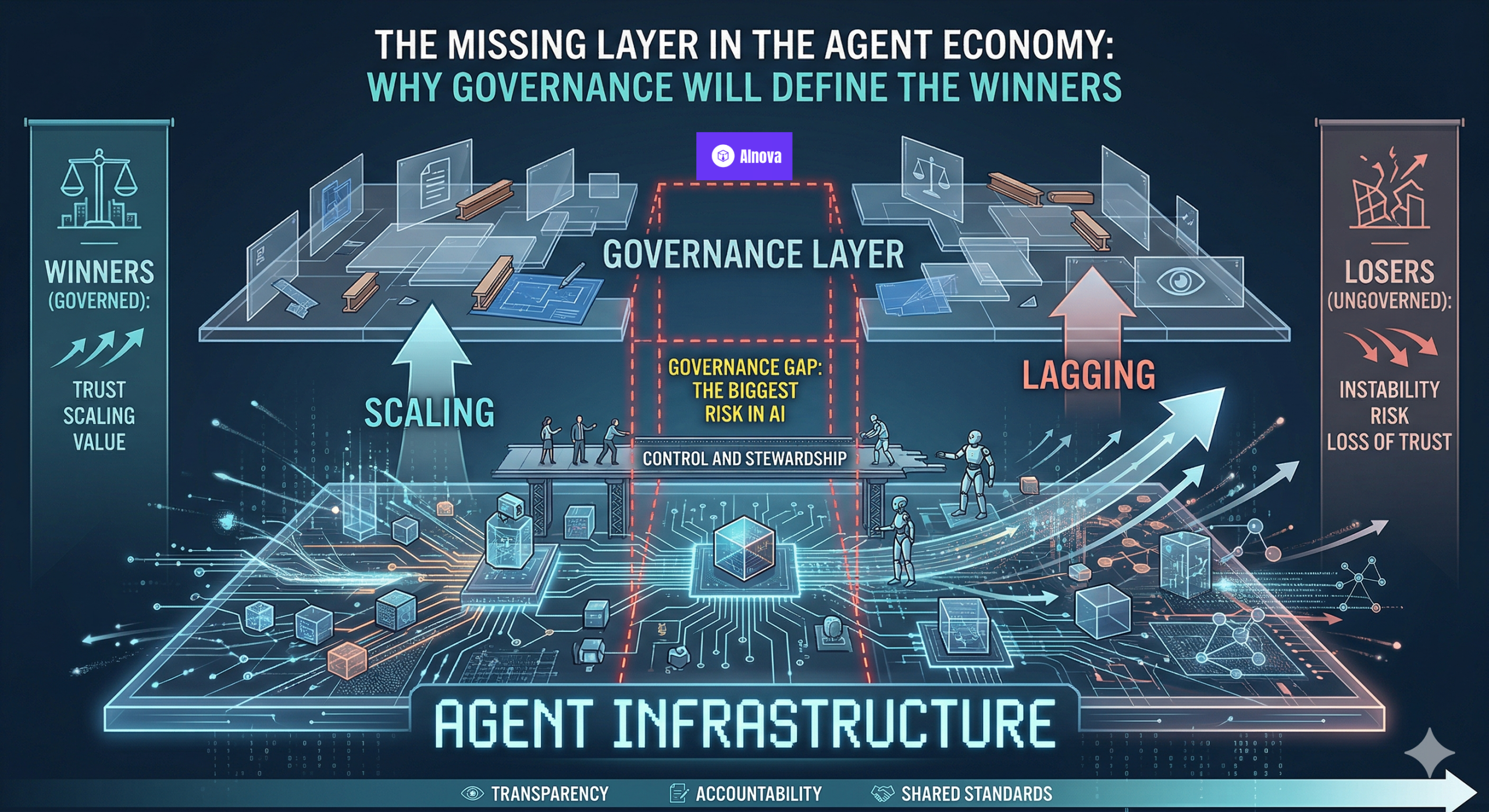
The Missing Layer in the Agent Economy: Why Governance Will Define the Winners
Agent infrastructure is scaling faster than our ability to control it. And that gap is about to become the biggest risk in AI.

The release of Claude Managed Agents signals something beyond a product launch.
It signals that the agentic era has entered production.
In the past twelve months, we have moved from demos to deployment. From sandboxed experiments to agents that execute multi-step workflows, access live APIs, trigger real-world transactions, and operate with meaningful autonomy across enterprise environments.
The first phase of the infrastructure race is effectively over.
Capability is no longer the bottleneck.
What comes next is not more capability. What comes next is control.
The Capability-Governance Gap
There is a structural asymmetry forming at the center of the AI stack.
On one side: agent capability is accelerating at an extraordinary pace. Reasoning improves. Context windows expand. Tool use becomes more reliable. Multi-agent orchestration is becoming table stakes.
On the other side: the governance layer is almost entirely absent.
Today’s agent deployments — even the most sophisticated ones — operate with no deterministic control mechanism. There is no system that enforces policy at runtime. No identity layer for individual agents. No budget constraint that cannot be circumvented. No audit trail that qualifies as legally defensible.
The industry is converging on how to build agents.
It has not yet converged on how to control them.
That is the gap Ainova addresses.
This is not a niche infrastructure problem. It is a category-defining gap.
Agents are not passive software. They:
- consume budget autonomously
- access sensitive APIs and proprietary data
- trigger real-world actions with downstream consequences
- operate across organizational boundaries
- scale unpredictably under compound conditions
In production environments, the absence of a governance layer does not create inconvenience. It creates liability.
The Historical Pattern
Every major infrastructure wave has generated a parallel control market. Without exception.
Cloud computing required cloud governance — IAM, policy enforcement, cost management, compliance tooling. A multi-billion dollar market emerged entirely from the need to control what cloud made possible.
APIs required API management — rate limiting, access control, versioning, observability. Companies like MuleSoft, Kong, and Apigee built substantial enterprises on this single layer.
Data required data governance — lineage, access, classification, regulatory compliance. The data governance market is now projected to exceed $7B by 2027.
In each case, the pattern is the same: capability scales faster than control, and control becomes the bottleneck that the next generation of infrastructure companies must solve.
If history is any guide, governance layers do not remain niche.
They become multi-billion dollar categories — because they are required for scale.
Agents are following this exact trajectory. The difference is that the stakes are materially higher.
Cloud resources sit idle when misconfigured. Agents act.
What the Market Is Missing
The current agentic ecosystem is producing:
- better reasoning models
- more capable tool-use frameworks
- improved orchestration layers
- lower inference costs
What it is not producing is a governance primitive.
A governance primitive means: a system that defines what an agent is, what it is allowed to do, how much it can spend, under what constraints it can operate — and that enforces these rules deterministically, at runtime, without exception.
Not a logging tool. Not an observability dashboard. Not a compliance checklist.
A control layer that is architecturally prior to execution — one that cannot be bypassed by the agent it governs.
This distinction matters. Observability tells you what happened. Governance determines what is allowed to happen.
Ainova: The Governance Operating System for Autonomous Agents
Ainova is building the category that this market will require.
We are not another agent builder. We are not an orchestration tool. We are not a wrapper around existing frameworks.
We are building the Governance OS — the deterministic control layer that sits above the execution stack and governs everything that runs beneath it.
Ainova does not add features to agents.
It redefines the conditions under which they are allowed to operate.
The Ainova architecture delivers:
Identity & Ownership — every agent has a verifiable identity, a defined owner, and an auditable chain of authority. No anonymous execution.
Policy Enforcement — every action is checked against a policy ruleset before execution. Policies are deterministic, not probabilistic. Rules are enforced, not recommended.
CapToken — a native economic control mechanism (programmable spending constraints for agents). Budget limits that cannot be circumvented.
GuardMesh — runtime enforcement across multi-agent networks. Policies propagate through the entire execution graph, not just the entry point.
TraceForge — a tamper-resistant audit trail that produces legally defensible records of every agent action, decision, and resource access.
LungClaw — a deterministic rule enforcement engine (non-LLM, non-probabilistic). The core of the governance stack. Not a policy suggestion system. A mechanism with no probabilistic behavior.
The Ainova Claude Adapter allows agents built on Claude — and any major framework — to operate under full governance constraints without modifying their execution model.
The adapter is already available and in use.
→ github.com/enkronos/ainova-claude-adapter
The Stack Is Already Emerging
The release of Claude Managed Agents validates a thesis we have held since inception:
Agent execution will commoditize. Control will capture value.
The future architecture is not monolithic. It is layered:
Agent Runtimes → Claude, OpenAI, open-source frameworks
Governance Layer → Ainova
Economic Control → CapToken, budget enforcement, cost optimization
Compliance Layer → EU AI Act, SOC 2, sector-specific regulation
Each layer serves a distinct function. The governance layer is not optional infrastructure — it is the precondition for enterprise adoption at scale.
What Platforms Like Claude Managed Agents Are Solving — And What They Are Not
Anthropic’s engineering work on Managed Agents is genuinely sophisticated. They decoupled the brain from the hands — separating the harness, session, and sandbox into independent interfaces. They solved context management across long-horizon tasks. They reduced time-to-first-token by over 90% at p95. They designed for resilience, for multi-brain and multi-hand architectures, for sandboxed credential handling.
What they are solving is execution complexity.
What they are not solving is control.
These are fundamentally different problems.
Managed Agents tells you how to run agents reliably. It does not tell you what agents are allowed to do. It manages sessions and sandboxes. It does not enforce policy. It abstracts harness complexity. It does not bound economic exposure. It separates credentials from sandboxes as an engineering constraint — not as a governance primitive.
The Anthropic article itself is explicit about this orientation: Managed Agents is designed to be “unopinionated about the specific harness that Claude will need in the future.” It is built for flexibility.
Governance, by definition, is the opposite of unopinionated.
This is not a criticism. It is a structural observation — and a market opportunity.
The more successful Managed Agents becomes, the more necessary Ainova becomes.
Because every new session, every new brain, every new hand added to the stack increases the surface area that requires deterministic control. Anthropic is expanding the perimeter. Ainova governs what operates inside it.
No enterprise risk officer will sign off on autonomous agents operating without a deterministic control mechanism. No regulated industry will deploy agentic systems without an auditable policy enforcement layer. No board will approve an AI strategy that cannot answer the question: what happens when an agent acts outside its mandate?
Ainova answers that question before it becomes an incident.
The Market Timing
Several forces are converging simultaneously.
Regulatory pressure is intensifying. The EU AI Act creates enforceable requirements for high-risk AI systems. Governance infrastructure is not a compliance nicety — it is a legal requirement for a growing class of deployments.
Enterprise adoption is accelerating. The Fortune 500 is moving from pilots to production. The question is no longer whether to deploy agents, but how to govern them at scale.
Model commoditization is underway. As inference costs fall and foundational capabilities converge, the differentiation layer moves up the stack. Governance is precisely where value concentrates when the underlying models become utilities.
Incident risk is rising. As agent autonomy increases, so does the surface area for consequential errors. The first major agentic incident — unauthorized transactions, data exfiltration, cascading failures — will accelerate enterprise demand for governance infrastructure in a way that no sales motion can replicate.
We are building before that inflection. That is where category-defining companies are built.
Why Now
The window for establishing the governance layer is open, but not indefinitely.
The patterns that will define this market — identity standards, policy primitives, audit formats, economic control mechanisms — are being established now, in the absence of dominant players. The companies that define these primitives will have the same structural advantage that AWS had in cloud infrastructure and Twilio had in communications APIs.
This is not a timing bet.
This is a structural inevitability.
We are building those primitives.
The Bottleneck Has Shifted
The venture opportunity in the agentic stack is not in building more capable agents.
It is in answering the question that every enterprise, every regulated industry, and every risk-conscious operator is already asking:
Can we control them at scale?
Ainova’s answer is yes — by design, by architecture, and by enforcement.
Not as a feature. As a foundation.
We believe agent governance will become as foundational as cloud IAM.
And we are building the company that defines it.
The future is not just agents.
It is governed agent systems.
And governance infrastructure is always built before the market fully understands it needs it.
Gianluca Busato – Ainova, Founder
Ainova is building the Governance Operating System for autonomous AI agents.
→ ainova.io
→ For investor inquiries: gianluca.busato@enkronos.com
